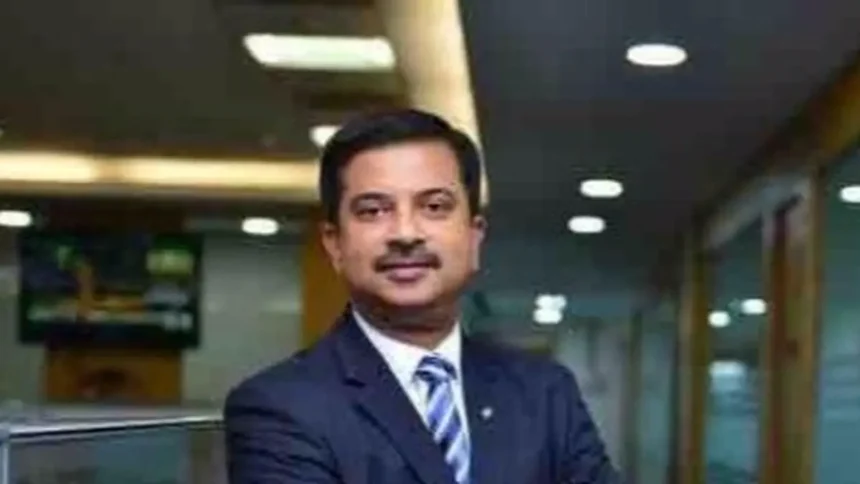

While Indian markets currently lack a dedicated AI leader and large IT services firms face potential disruption from artificial intelligence, Swarup Mohanty, CEO and Vice President of Mirae Asset Mutual Fund, believes India could serve as a “non-AI hedge” in global investment portfolios as capital allocation to technology peaks.
In an exclusive interview with ANI, Mohanty noted that Indian IT companies, traditionally regarded as stable revenue generators and vital to the country’s export economy, are under pressure as investors shift heavily toward AI-related stocks. “The stock performance has reflected that for the most part,” he remarked.
Despite these challenges, he expressed optimism about the adaptability of India’s IT sector. “They are too skilled and experienced to not find their way at all,” he stated, mentioning his personal connection to the industry, with his son employed at one of the firms. Mohanty emphasized the necessity for Indian IT companies to demonstrate credible AI capabilities to remain relevant in the next technological wave. “We have to showcase that otherwise we will be dramatically left out in that space,” he cautioned.
Although India may not have a prominent role in AI hardware or chip production compared to the U.S. or Korea, Mohanty argued that the demand for IT services will continue. “There will still be a lot of work for our IT companies in that space,” he said, though acknowledging they may occupy a less dominant position.
He pointed out that capital flows in cycles, with recent years seeing investments largely bypass the non-AI sector as funds pursued AI opportunities. However, once allocations to AI reach saturation, fund managers will seek value elsewhere, potentially bringing India’s economic narrative back into focus. “The diversity of the market and the fact that this is the only economy growing at 6 percent will come into play today or tomorrow,” he predicted.
Mohanty drew comparisons with South Korea, which saw minimal market movement over seven to eight years before experiencing substantial gains in the last year and a half. He argued that even if India does not secure a strong foothold in AI, it can still attract investment as a consistent, high-growth economy.
“When you look at the rest of the portfolio, there is enough and more that India is offering for finding merit in everybody’s portfolio,” he said. He also highlighted valuations as a crucial factor influencing investment decisions. Despite some belief that Indian markets were overvalued in 2024, leading to capital withdrawal, he asserted that the situation changes when prices correct.
“You buy a good stock at a good price. That India is a good story is a foregone conclusion. There is no country growing at 6 percent, even after the oil shock has taken 1 percent off growth,” he explained. “When the price is right, make no mistake, money will come back. There’s no doubt or debate.”
Mohanty emphasized that India’s economic and market fundamentals, including domestic consumption and policy stability, position it favorably amid global uncertainties. “The entire length and breadth of the Indian economy to the stock market, to basic life in general, has been exposed to some gaps in the world. And it’s how quickly we fill these gaps will define our next decade forward,” he concluded.