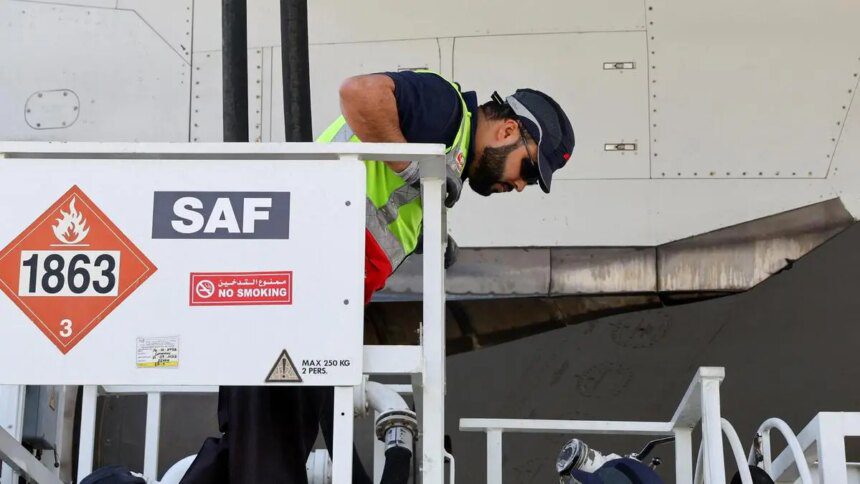

The Ministry of Petroleum & Natural Gas has announced a new regulation allowing the blending of synthesized hydrocarbons, including Sustainable Aviation Fuel (SAF), with aviation turbine fuel (ATF). This initiative is part of the effort to decarbonize the aviation sector and is designed to be supported by renewable feedstocks such as ethanol, agricultural residues, biomass, waste oils, and municipal waste.
In a notification dated April 17, 2026, the ministry revised the Aviation Turbine Fuel (Regulation of Marketing) Order, 2001. The new provision states, “Aviation turbine fuel is a complex mixture of hydrocarbons conforming to IS 1571 specification or its blend with synthesized hydrocarbons.”
Vijay Nirani, Managing Director of TruAlt Bioenergy, emphasized the significance of this amendment, indicating that it creates a clear pathway for SAF to be integrated into the mainstream aviation ecosystem. He noted that while the update may initially seem technical, it represents a crucial shift in India’s energy trajectory and offers the industry increased regulatory certainty for long-term investments.
The amendment also includes updates to the legal procedures for enforcement and compliance. According to the notification, “The provisions of section 103 of the Bharatiya Nagarik Suraksha Sanhita, 2023 (46 of 2023), relating to search and seizure shall, as far as may be, apply to searches and seizures under this order.” This regulatory clarity is expected to enhance the use of SAF and decrease crude oil imports, which currently account for over 85% of India’s requirement.
The government has set ambitious targets for SAF blending, aiming for 1% by 2027, 2% by 2028, and 5% by 2030.
Moreover, the All India Distillers Association (AIDA) reported that India’s success in achieving E20 blending significantly supports SAF development through the Ethanol-to-Jet (ETJ) pathway. This plan capitalizes on India’s extensive ethanol capacity, existing distillery infrastructure, and established farmer-linked supply chains.
A report by Deloitte India, released in October 2024, highlighted that India’s surplus of 230 million tonnes of agricultural residue would be critical for producing SAF. This surplus is anticipated to serve as a key feedstock for second-generation ethanol production, which is essential for the Alcohol-to-Jet (AtJ) technology pathway for SAF manufacturing.
The AtJ process, utilizing first-generation ethanol from sugar and grains, could provide an initial boost until the technology is fully developed. In addition to this, municipal solid waste and used cooking oil are positioned to enhance overall SAF production potential. Alternative feedstocks such as sweet sorghum, seaweed, and industrial waste may further accelerate SAF manufacturing as technology matures.
Published on April 22, 2026.