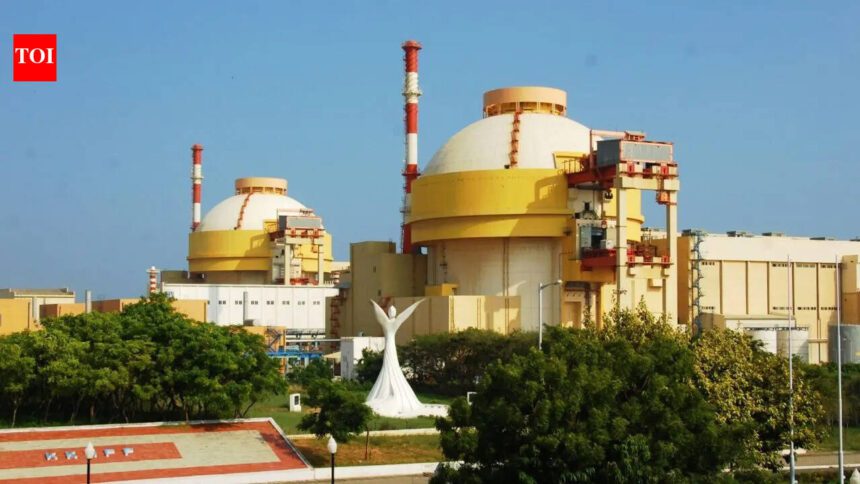

India is making significant strides toward opening its nuclear power sector to foreign investment, with the Atomic Energy Commission (AEC) recently approving a new foreign direct investment (FDI) framework, according to official sources.
Seema S. Jain, a member of the Department of Atomic Energy, highlighted this development during a workshop in New Delhi, noting that the new policy is part of a broader initiative to attract substantial financing aimed at expanding nuclear energy capacity. “The Atomic Energy Commission has approved the FDI policy, and it is going for ministerial consultations,” Jain stated. She also emphasized the benefits of a “fleet mode” strategy, where multiple reactors would be constructed at a single location to expedite both approvals and construction timelines.
India has set an ambitious target of increasing its nuclear power capacity to 100 gigawatts by the year 2047, a goal that will necessitate significant investment. Despite advancements in policy, the National Thermal Power Corporation (NTPC) has observed less interest from private companies than expected, underscoring the challenges associated with attracting external capital. The proposed FDI policy, which is bolstered by the recently enacted SHANTI Act 2025, aims to secure investments totaling up to ₹20 lakh crore from foreign stakeholders to accelerate the establishment of nuclear reactors.
The SHANTI Act, enacted on December 21, 2022, was intended to create a unified framework of legislation that facilitates private sector participation in research and innovation for the peaceful application of nuclear energy, subject to licensing and safety authorization requirements.
Historically, the slow expansion of nuclear power capacity in India was attributed to a technology development phase hampered by international embargoes and a technology denial regime, paired with limited resource availability, as per a recent statement from the Department of Atomic Energy.