
At Tekhali Bridge, a site known for its association with the 2007 land acquisition protests that resulted in 14 fatalities, the atmosphere is dominated by saffron flags. Many display the slogan “Jai Shri Ram,” alongside images of the Ram Temple, while some bright yellow flags proclaim “Joy Bangla.” Notably absent are flags from the Bharatiya Janata Party (BJP) or the Trinamool Congress. This visual landscape persists across Reyapara, Sonachura, and Mohammadpur, signaling the rise of identity politics in Nandigram.
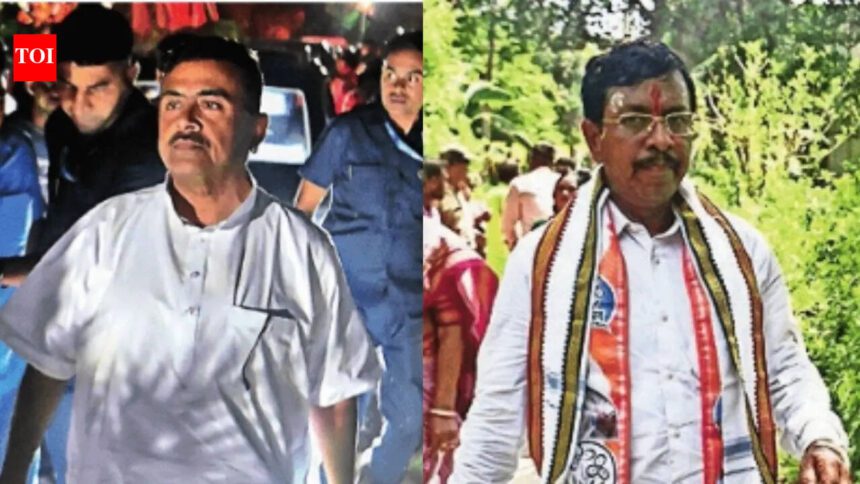
Suvendu Adhikari, the BJP candidate, stated, “You can blindfold me, but I would still know Nandigram like the back of my hand,” referring to his longstanding connection to the area. He asserted his influence, recalling his role in the 2004 protests and his victory over Chief Minister Mamata Banerjee in 2021. Adhikari had just concluded an election meeting at Binandapur, located roughly 5km from the Nandigram bus stand.
The conversation at the meeting reflected a focus on religious identity politics. A local, Bapi Das, remarked, “Sanatanis will trounce Adharma,” emphasizing Adhikari’s standing in the community. He asserted, “He made Nandigram what it is today.” Adhikari noted the stark voting demographics, stating that he secures around two votes from the Mohammadpur Madrasah booth—predominantly Muslim—while receiving approximately 400 from a nearby Hindu-majority high school. Adhikari urged the crowd to unite, emphasizing inclusivity in his outreach efforts, claiming to have aided members of the minority community targeted by Trinamool violence.
Despite his confidence, Adhikari is actively campaigning, visiting each of the 17 anchals in his constituency nearly every evening. His opponent from the Trinamool Congress, Pabitra Kar, is a significant contender. As a former confidant of Adhikari, Kar embodies a challenge to him, bringing deep connections within Hindu organizations such as Hindu Samhati and Sanatani Sena. Kar criticized Adhikari’s track record, asserting that Nandigram has suffered from “empty assurances” and pledging to bring genuine development.
Political analysts caution that the electoral battle in Nandigram will hinge on demographic segments. Recently, about 12,500 Muslim voters were reportedly removed from the electoral rolls, exacerbating tensions. Allegations of intimidation from Adhikari have likely added to discomfort among Muslim voters. Kar has adopted a measured grassroots campaign strategy, working to enhance local connections and support.
According to research from the Sabar Institute, although Muslims make up approximately 25% of Nandigram’s population, nearly 95.5% of the voters struck from the supplementary list belong to this community. Residents like Rubina Bibi from Mohammadpur expressed uncertainty about their voting eligibility, highlighting a growing concern among the electorate.
Beyond political divides, community members voiced frustrations over local infrastructure, with residents complaining of inadequate connectivity and employment opportunities. Tarun Das from Reyapara stated, “We have a railway station, but no rail line,” pointing to ongoing infrastructural shortcomings. Trader Swadesh Jana from Tangua Bazar remarked on the volatility of local politics, observing that today’s political affiliations seem to shift rapidly amid intimidation and financial pressures.