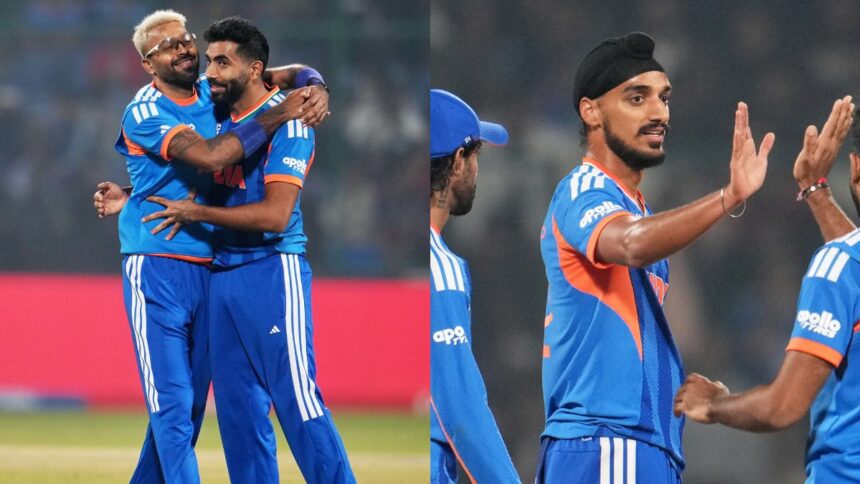

India have won four consecutive matches in the ongoing T20 World Cup and will face South Africa on Sunday in their opening game of the Super 8 round. The match will be played at the Narendra Modi Stadium in Ahmedabad where the Indian bowlers are also expected to create history, breaking Ravichandran Ashwin’s all-time T20 World Cup record for India.
Ashwin is currently the leading wicket-taker for India in the mega event, with 32 wickets at an average of 17.25 and an economy of only 6.49. However, his record is certain to be broken in the ongoing edition with three bowlers – Jasprit Bumrah, Arshdeep Singh and Hardik Pandya following him closely.
Both Bumrah and Arshdeep have accounted for 30 wickets each so far in 21 and 17 T20 World Cup matches and both average just over 14. Hardik Pandya, the premier all-rounder, is also in the race to break Ashwin’s record with 29 scalps to his name in 25 innings so far.
These three bowlers might even go past Ashwin in the ongoing edition and it remains to be seen who will finish on top by the end of the tournament.
Most wickets for India in T20 World Cup history
Ravichandran Ashwin – 32 wickets
Jasprit Bumrah – 30 wickets
Arshdeep Singh – 30 wickets
Hardik Pandya – 29 wickets
Ravindra Jadeja – 22 wickets
Who is the leading run-scorer for India in T20 World Cup history?
As far as the leading run-scorer is concerned, Virat Kohli is on top of the list not only for India but also in the world with 1292 runs in just 33 innings at an average of 58.72 and a strike rate of 128.81 with 15 fifties to his name. There is no immediate threat to his record as Rohit Sharma is next on the list with 1220 runs and like Kohli, even he is retired from the format. Suryakumar Yadav is the next player for India on the list with 642 runs in 21 innings at a strike rate of 152.49.
Also Read
</div>