
Subrata Thakur appears comfortable discussing the principles of the Matua community and its historical evolution, initiated by Harichand Thakur and Guruchand Thakur. As the grandson of P.R. Thakur, the first barrister from the marginalized Namasudra community, and Matua matriarch Baroma Binapani Devi, Subrata emphasizes the importance his family places on social dignity, education, and employability for the community’s advancement.
Currently serving as the MLA and BJP candidate for the upcoming April 29 election, Subrata met with reporters at the expansive Thakurbari campus in Thakurnagar, Gaighata, in North 24 Parganas. This election, however, poses challenges for him and other BJP leaders within the Matua demographic. They are grappling with significant voter-list deletions under the Systematic Identification of Residents (SIR) amid the oppressive April heat.
Subrata acknowledges the concerns but claims these deletions are not the result of legitimate exclusions. He links most cases to the previous SIR implemented in 2002, citing glitches, missing uploads, and potential political sabotage as causes. The BJP is actively assisting individuals in filling out Form 6 to restore their names, reassuring the community, “do not panic, you are safe in India, CAA is there, and the BJP will get your names back.” He likens the situation to cleaning a house where “sometimes a few glasses get broken.”
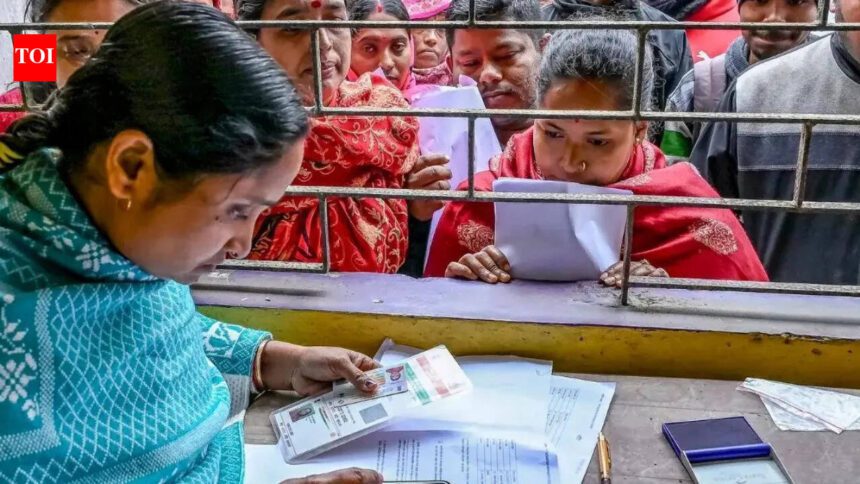
The historical backdrop of the community, marked by Partition, migration, and the struggle for documentation, remains relevant today, even 70 years post-Independence. Voter deletions highlight the anxiety surrounding this issue. Out of 142 Assembly seats voting in the second phase, 1,287,622 electors faced deletions during judicial adjudication. Specifically, in North 24 Parganas, which has a significant Matua population, 591,252 voters underwent adjudication, with 325,666 declared ineligible. In the Bongaon area, the impact is stark, with the Gaighata constituency reporting 19,638 deletions, while in Bagdah, 5,890 exclusions occurred from 13,459 flagged cases.
While the Citizenship Amendment Act (CAA) has been proposed as a solution to this predicament, its implementation on the ground is more complex. Local help centers at the Thakurbari campus appear underutilized, with some community members expressing frustration over application delays. Many hesitate to apply, fearing it suggests they are not already Indian citizens. In response to these complications, Subrata states that the Union home ministry is conducting thorough cross-checks.
This evolving situation forms part of the BJP’s broader strategy in the Matua belt. Recently, Prime Minister Narendra Modi and Home Minister Amit Shah have revisited the issue, projecting promises of citizenship and support for Hindu families of refugee origin. Modi emphasized his visit to Orakandi in Bangladesh, the birthplace of Harichand Thakur, to underscore his commitment to the community, while Shah accused the Trinamool Congress (TMC) of orchestrating voter deletions and creating fear.
Conversely, the TMC has framed this issue as a betrayal. Abhishek Banerjee of the TMC criticized the BJP, claiming they have failed to deliver on citizenship and job promises, labeling their concern for the community as “crocodile tears.” Mamata Banerjee, in her campaign, condemned the SIR exercise as deceptive, analogizing it to a “got-up game,” where family members appear differently on voter rolls.
Subrata Thakur rebuffs these TMC allegations, asserting that fear is being manipulated by the party to sway public sentiment. He points to a historical context where Matuas faced systemic degradation, being marginalized and denied dignity. He highlights the influential legacy of Harichand and Guruchand Thakur, noting their focus on education, self-respect, and advocacy for the community.
The BJP has capitalized on the community’s insecurities through promises of CAA in previous elections. In 2021, the party won all four Matua-heavy Assembly seats in the Bongaon subdivision and has maintained leads in the same constituencies for the 2024 Lok Sabha election. The Matua community, comprising the second-largest Scheduled Caste group in Bengal, is believed to influence 50 to 70 Assembly seats, but the current climate presents challenges for the BJP in retaining that support.
Subrata downplays the significance of Mamata’s outreach, stating she only sought Matua votes prior to 2011. According to him, once she secured Muslim support, the community became less crucial. The mood among voters fluctuates; some are confident in the BJP’s ability to restore their names, while others report family members being affected by the deletions.
Additionally, a split within the Thakurbari community complicates matters further. In Gaighata, Subrata is running for the BJP while his brother Shantanu Thakur’s wife, Soma, is contesting in Bagdah against a sitting TMC member. This division illustrates the intra-family conflict alongside the BJP-TMC rivalry.
In summary, the central question for voters in Thakurnagar is whether their trust in the BJP can be rekindled alongside the return of their names. The uncertainty generated by the SIR has propelled the community’s apprehensions back into the campaign narrative. Whether the BJP can quell these concerns and sustain its electoral foothold will become clearer on May 4.