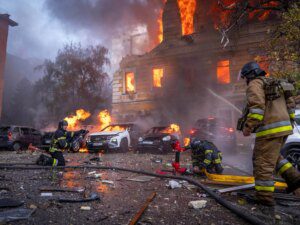
In a continuing escalation of violence, Russian drones struck the National Academy of Sciences in Kyiv, killing at least seven people and injuring over 80. These attacks reflect a broader strategy by Moscow targeting civilian sites, raising concerns about the humanitarian situation and the ongoing conflict that has persisted for over four years.
Recent Attacks on Ukrainian Capital
On Monday, the historic centre of Kyiv was subjected to aerial bombardment, with reports indicating that residential blocks, commercial offices, petrol stations, data centres, and cultural sites were targeted. The violence led to significant casualties, with a particular incident resulting in the death of a woman near the German embassy. Eyewitnesses reported chaotic scenes where staff evacuated through firefighters’ ladders as flames engulfed parts of the building.
Mayor Vitali Klitschko condemned these strikes, describing them as acts of “pure terror” aimed at disrupting daily life and breaking the spirit of the civilian population. Such assaults highlight the ongoing volatility in Ukraine’s capital and underscore the challenges faced by civilians amid warfare.
Wider Impact Across Ukraine
The violence was not confined to Kyiv. In the city of Dnipro, three individuals lost their lives in a drone strike targeting an office centre, with additional injuries reported in Kharkiv, Zaporizhzhia, and Odesa. The Ukrainian government has accused Russian forces of systematically attacking civilian infrastructure while Moscow claims the strikes focus on military assets.
The implications of such attacks extend beyond immediate casualties. Economic disruptions, destruction of infrastructure, and a growing humanitarian crisis compound the challenges for the Ukrainian government, as it grapples with not just military strategies but also the welfare of its citizens faced with ongoing conflict.
The Global Response and Humanitarian Crisis
The international community remains closely monitoring the situation. As reports of civilian casualties rise, calls for increased humanitarian assistance and intervention have intensified. Global organizations are working to provide support to those affected by the violence, although access remains hampered by the active conflict.
The ramifications of this conflict extend beyond borders, stirring discussions about international law, human rights violations, and potential sanctions against Russian actions. Nations around the world, including India, are impacted as the conflict continues to disrupt global supply chains and fuel geopolitical tensions.
What This Means
For Indian readers, the escalating violence in Ukraine highlights significant issues concerning global security and humanitarian law. The conflict could have ramifications for international relations, particularly with the ongoing discussions surrounding Russia. India’s position as a neutral player in this conflict necessitates a keen observation of how these developments influence regional stability and economic ties, particularly in energy and trade.
Frequently Asked Questions
How has the recent violence affected civilians in Ukraine?
The recent attacks have resulted in numerous civilian casualties and injuries. Infrastructure destruction further complicates the plight of civilians, causing disruptions in essential services and daily life.
What humanitarian efforts are being made for those affected?
Various international organizations are seeking to provide humanitarian assistance, but access remains limited due to ongoing military operations. Efforts include medical support, food supplies, and shelter for displaced persons.
How is the international community responding to the situation?
There are increasing calls from the international community for intervention and support for Ukraine, with some countries considering sanctions against Russia. Human rights organizations are also pressing for accountability for civilian casualties.
What does this mean for global geopolitics?
The conflict influences global alliances, economic sanctions, and security strategies worldwide. Nations are recalibrating their foreign policies in light of these developments, especially concerning energy demands and trade relations.