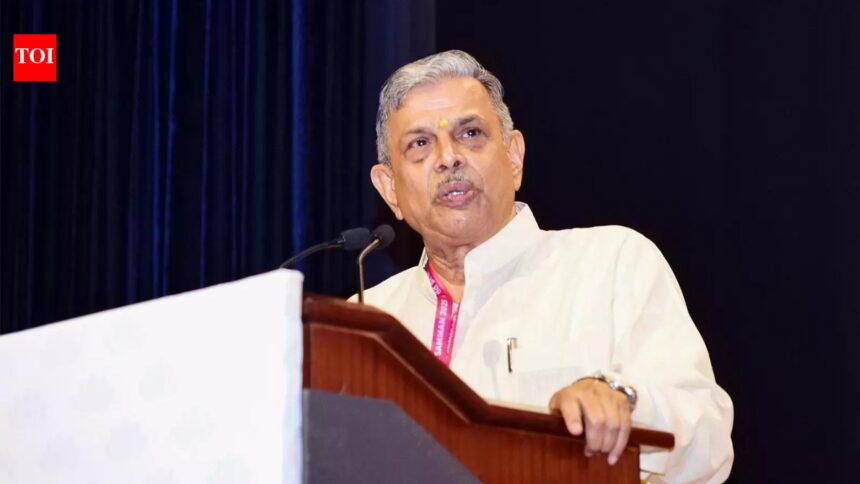

When a senior functionary from the Rashtriya Swayamsevak Sangh (RSS) enters policy and technology circles at Stanford and the strategic think-tank ecosystem in Washington—spaces that have traditionally scrutinized the organization—it reflects a deliberate effort to shape the global narrative. This context surrounds RSS General Secretary Dattatreya Hosabale’s tour of the U.S. and Germany in April, coinciding with the RSS’s centenary celebrations. Academic environments in the U.S., particularly within Ivy League institutions, have produced strong critiques of the RSS and its ideological underpinning, Hindutva.
During this outreach, Hosabale’s schedule was notable. He addressed participants at THRIVE 2026 in Silicon Valley, engaged in policy discussions at the Hudson Institute on April 23, interacted with the Indian diaspora, and participated in an interview with NPR. At Hudson Institute, he confronted the longstanding perceptions around the RSS, stating, “This mis-propaganda has taken place for decades. They have portrayed RSS as a Hindu supremacist organisation, as anti-minority, anti-women.” He added that historically, “RSS was working silently… now we thought that it’s better to reach out. Our words should also become the message.”
Hosabale’s address at THRIVE 2026 was oriented towards a global audience in technology and academia, where he invoked themes of civilizational unity, saying, “We are all part of the same source of energy… one planet, one family, one shared future.” He emphasized the need for scientific and technological advancements to be guided by ethical considerations. In his NPR interview, Hosabale took a political stance, asserting, “We are not establishing anew any Hindu nation.”
The critical discourse in U.S. academia about the RSS and Hindutva is substantial. For instance, a Columbia University publication, The Morningside Post, described RSS-linked networks as associated with an “ethnofascist paramilitary group.” A 2020 paper published in SAGE Journals characterized the RSS as having a “close relationship” with a “semi-fascist” ideological project aimed at establishing a Hindu rashtra. Additionally, the 2021 Dismantling Global Hindutva conference, supported by various Ivy League departments, positioned Hindutva as a political ideology distinct from Hinduism while warning of its global ramifications, leading to responses from Indian factions.
During his meetings with notable German policy institutions such as Stiftung Wissenschaft und Politik and Konrad-Adenauer-Stiftung, as well as with members of Berlin’s Abgeordnetenhaus, Hosabale articulated, “RSS’s vision for the next 100 years is to contribute to building sustainable societies at every level, from families to societies and environmental responsibility, grounded in shared universal values.”
This outreach indicates a transition in the RSS’s communication strategy. According to a Sangh insider, the organization, which historically relied on grassroots efforts and limited international engagement, is now aiming to “engage directly with international opinion-makers.”