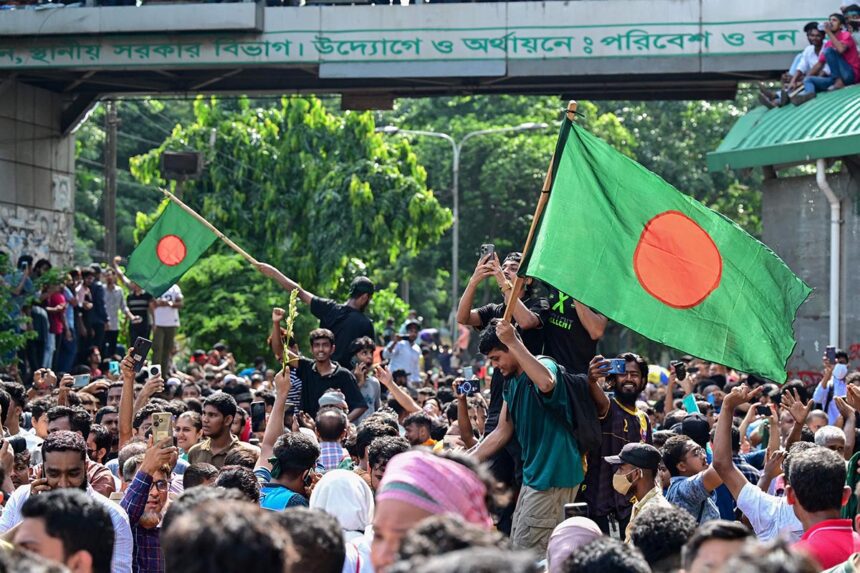

On August 5, Bangladesh witnessed a dramatic political upheaval as Prime Minister Sheikh Hasina resigned amidst escalating protests against controversial government job reservations, marking a significant shift in the country’s governance. Her departure sparked celebrations in Dhaka but also gave rise to troubling misinformation that could potentially inflame communal tensions in the region.
Background of the Protests
The resignation of Sheikh Hasina, who had been in power since 2009, was precipitated by widespread dissatisfaction among various groups regarding a new policy that allocated a 30% quota in government jobs and educational institutions to select groups, including the descendants of freedom fighters. The protests began peacefully in June, but as public discontent grew, they escalated into a broader movement demanding Hasina’s ouster. This unrest intensified over the weekend prior to her resignation, resulting in violent clashes that claimed over 100 lives. The government resorted to extreme measures, such as an internet shutdown and the imposition of a nationwide curfew, to control the situation.
Post-Resignation Chaos
In the aftermath of Hasina’s departure, jubilant crowds in Dhaka celebrated by vandalizing her official residence and accosting her belongings. Reports emerged of celebratory protests turning violent, with acts such as the defacement of a statue of Sheikh Mujibur Rahman, Hasina’s father and the founding leader of Bangladesh. The fall of Hasina’s administration not only led to a leadership vacuum but also ignited fears of unsettled communal tensions. As chaotic footage spread across social media, alarm arose in neighboring India, where unverified claims accused the Muslim population in Bangladesh of attacking Hindus.
Misinformation and Social Media Dynamics
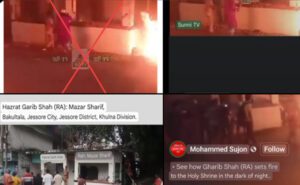
The speed at which misinformation spread regarding the purported violence against Hindus in Bangladesh illustrates the challenging dynamics of social media in political discourse. Right-wing social media accounts incited panic by disseminating fabricated narratives, alleging assaults on the Hindu minority and falsely depicting them as widespread. Despite the anxiety surrounding the safety of minorities, many reports were debunked by fact-checkers like Mohammed Zubair, who exposed misleading claims, including a video of an unrelated incident being falsely attributed to communal violence in Bangladesh.
Why This Matters
The political turmoil in Bangladesh and the subsequent reactions in India highlight the frailty of communal harmony and the ease with which misinformation can influence public perception. As fears about the safety of Hindu minorities in Bangladesh circulate, the propagation of fake news can lead to significant social discord in India, particularly within its own minority communities. This incident serves as a crucial reminder of the need for responsible political dialogue and the integrity of information in a rapidly evolving digital landscape.
Frequently Asked Questions
What led to Sheikh Hasina’s resignation?
Sheikh Hasina resigned due to massive protests against a government policy that reserved 30% of jobs for specific groups, which escalated into a larger movement calling for her ouster amid increasing violence and civil unrest.
How are the protests affecting Hindu-Muslim relations in India?
The protests and subsequent misinformation regarding violence against Hindus in Bangladesh are causing apprehensions among communities in India, potentially leading to heightened tensions between Hindu and Muslim populations.
What steps are being taken to address misinformation?
Fact-checkers like Mohammed Zubair are actively debunking false narratives on social media and aiming to provide clarity regarding incidents occurring in Bangladesh to prevent misinformation from spreading.
How are the Bangladeshi people responding to the unrest?
While there have been celebratory protests following Hasina’s resignation, many members of the Bangladeshi Muslim community are also calling for communal harmony and the protection of minority populations amid the chaos.

![Community members raise their arms during a gratitude poem at a supper in Westbrook, Maine, in July 2025 [Courtesy of Community Plate]](https://www.indianewsweek.com/wp-content/uploads/2026/09/Potluck-Parties-Surge-in-Popularity-Across-America-A-Culinary-Revival-150x150.jpeg)