
NEW DELHI: Defence Minister Rajnath Singh urged defence scientists to expedite research and development efforts, emphasizing that “the battlefield of tomorrow will reward those who can shorten the time between an idea, a prototype, and operational deployment.” In a video message at the defence strategic dialogue Kalam & Kavach 3.0, he highlighted the growing necessity for national strength through rapid collaboration among defence forces, research labs, and industries.
He underscored the importance of self-reliance and jointness in securing strategic autonomy and preparing for emerging security challenges. “National security demands our preparedness, resilience, innovation, and strategic confidence,” said Singh. He articulated that self-reliance is not just an economic goal but a strategic imperative, asserting that nations overly dependent on others for critical defence capabilities face vulnerabilities during crises.
During the event, attended by Italian and Armenian ambassadors, Minister of State for Defence Sanjay Seth noted that India values global security and advancement through cooperation, trust, and shared innovation. He reported a significant increase in defence exports from Rs 686 crore a decade ago to a record Rs 38,424 crore today. Seth confirmed that annual defence production has reached an all-time high of Rs 1.54 lakh crore for the financial year 2025-26, reiterating the government’s commitment to achieving a target of Rs 50,000 crore in defence exports and Rs 3 lakh crore in defence production by 2029-30.
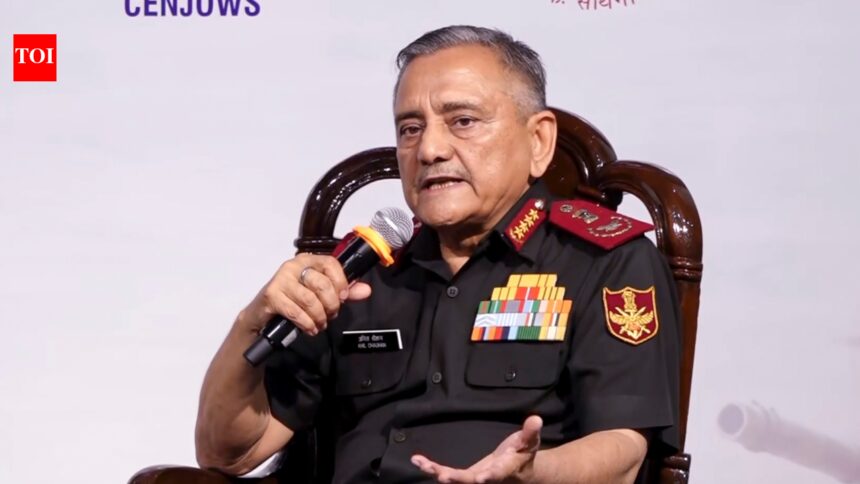
In a special session discussing Operation Sindoor, Chief of Defence Staff Gen Anil Chauhan asserted that the Indian armed forces “dominated the escalation matrix on all four days” of the conflict. Addressing the ‘JAI’ triad—jointness, atmanirbharta (self-reliance), and innovation—Chauhan mentioned ongoing efforts to enhance the scale and speed of planned theatre integration, noting that India is lagging behind other countries by 10 to 15 years in implementing such structures. He described these joint structures as potentially transformative reforms for India, contrasting his approach of consensus-building with other countries’ more top-down methods involving legislation.