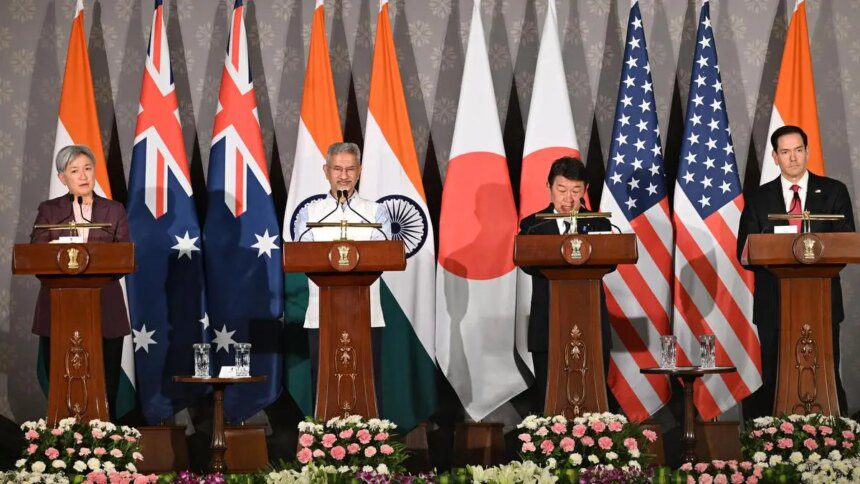

Countering China’s dominant role in global critical mineral supplies, the Quad partners—India, the United States, Australia, and Japan—have unveiled a critical minerals framework aimed at mobilizing up to $20 billion to strengthen supply chains. During a joint press conference held at Hyderabad House in New Delhi, the grouping also voiced concerns regarding Iran’s shipping toll policies in the strategic waterways of the Strait of Hormuz and the Red Sea.
Though not explicitly naming China, the Quad Foreign Ministers expressed alarm over “dangerous and coercive actions” occurring in the East China Sea and South China Sea, highlighting issues such as economic coercion, non-market practices, arbitrary export restrictions, price manipulation, and supply disruptions linked to critical minerals.
In a joint statement released on Tuesday, the Quad Foreign Ministers emphasized the essential nature of diversified and reliable global supply chains and the necessity to reduce dependence on any single country. “To advance our vision, we are pleased to announce the Quad Critical Minerals Framework,” they stated.
The meeting was convened by Indian External Affairs Minister Subrahmanyam Jaishankar and included Australian Foreign Minister Penny Wong, Japanese Foreign Minister Toshimitsu Motegi, and US Secretary of State Marco Rubio.
West Asia Concerns
The Ministers also deliberated on the ongoing situation in West Asia, reaffirming their support for diplomatic initiatives and expressing hope for sustained peace in the region. They underscored the importance of secure and uninterrupted global commerce through the Strait of Hormuz and the Red Sea, condemning attacks on commercial vessels and opposing any actions inconsistent with the United Nations Convention on the Law of the Sea (UNCLOS), such as the imposition of tolls.
Iran, facing significant reconstruction costs from conflicts involving the US and Israel, has officially enacted “service charges” on commercial ships traversing the strait.
Indo-Pacific Focus
Additionally, the Foreign Ministers launched the Indo-Pacific Maritime Surveillance Collaboration (IPMSC) to enhance information sharing and protect industrial supply chains. The new Quad Initiative on Indo-Pacific Energy Security is also aimed at pooling resources for cooperation in energy technology, policy, and emergency responses.
The Quad plans to allocate the $20 billion for critical minerals through various public and private sector mechanisms, including export credit agencies, development finance institutions, loans, guarantees, and subsidies. The Ministry of External Affairs indicated that this funding would target strategic critical mineral projects with a “Quad nexus,” specifically focusing on projects located in partner countries or those supplying Quad markets, in an effort to address supply chain vulnerabilities.
Published on May 26, 2026