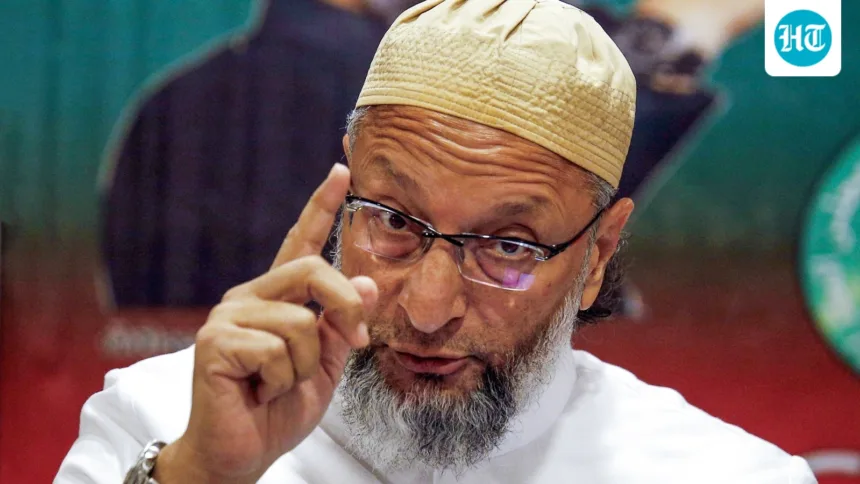

A recent ruling by the Allahabad High Court dismissing a minor student’s request to wear a Hijab alongside her school uniform has sparked strong criticism from AIMIM president Asaduddin Owaisi. He argues that the decision constitutes an “attack on Islam,” raising concerns about religious freedom and the rights of Muslim students in educational settings.
Context of the Ruling
The controversy began when a student from a school in Prayagraj sought permission to wear a Hijab in addition to the prescribed school uniform. The Allahabad High Court ruled against her, stating that she failed to present any religious texts or precedent that would classify the Hijab as an essential part of her faith. The court further noted that other students from the same community were photographed without scarves, suggesting that the dress code was adhered to by some.
The ruling emphasized that the determination of uniform policies primarily lies within the school’s jurisdiction, provided these guidelines are made in good faith and are non-discriminatory. The court argued that such policies are necessary for maintaining discipline and institutional identity.
Owaisi’s Critique
Responding to the court’s decision, Owaisi addressed a gathering in Darussalam, labeling the judgment as contrary to Articles 25 and 19 of the Indian Constitution. He asserted, “Who are you to decide what is essential to Islam? Girls are wearing hijab on their heads, not on their minds. It is an attack on Islam.” Owaisi criticized the timing of the ruling, pointing out that the Sabarimala case, which also questions issues of religious essentiality, is pending before the Supreme Court.
By framing the ruling as an infringement on personal religious practices, Owaisi highlights a growing narrative among some Muslim communities in India: the belief that judicial actions increasingly undermine their cultural and religious identity. His statements resonate with concerns prevalent among Muslims in India regarding the perceived encroachment on their rights by right-wing political factions.
Implications for Religious Freedom
The ruling has broader implications for the status of religious freedom in India, particularly for minority communities. Under the current political climate, where the ruling government has often been accused of fostering an environment of exclusivity, cases like this further fuel the narrative of marginalization faced by Indian Muslims.
The inability of the minor student to assert her right to wear the Hijab in a school setting reflects a disconnect between legal interpretations of religious freedom and the lived realities of individuals. It raises critical questions about how educational institutions navigate cultural diversity within their frameworks while adhering to national policies. The overarching narrative of exclusion can lead to an environment where Muslim students feel alienated, affecting their educational experiences and sense of belonging.
Why It Matters
The ruling reflects larger trends in India that may signal a shift in the balance between state mandates and individual rights, particularly for religious minorities. For many, it underscores the urgency for a dialogue on religious freedoms and how they are upheld or curtailed in educational systems. This case also invites scrutiny into how policies are formulated and implemented in India, impacting social cohesion and diversity. The implications extend beyond education, resonating through social, political, and economic contexts where the voices of marginalized communities must be heard for the democratic fabric to remain intact.
Frequently Asked Questions
What was the ruling of the Allahabad High Court regarding the Hijab?
The Allahabad High Court dismissed a petition by a minor student seeking to wear a Hijab along with her school uniform, stating she did not provide sufficient religious texts to prove the Hijab as essential to her faith.
What are Owaisi’s main arguments against the court’s decision?
Asaduddin Owaisi criticized the ruling as an “attack on Islam,” claiming it violates Articles 25 and 19 of the Indian Constitution, and questioned who has the authority to define what is essential to the religion.
How has this ruling affected the Muslim community in India?
The ruling is viewed by many in the Muslim community as part of a broader pattern of discrimination and exclusion, raising concerns about the diminishing space for religious practices in public life, particularly in educational settings.
What are the implications of this ruling for educational institutions in India?
This case may prompt educational institutions to reconsider how they approach and implement dress codes, especially in contexts where they intersect with religious freedoms, potentially affecting policies across various schools.