

Global geopolitical tensions in West Asia have led to volatility in financial markets, prompting investors to reevaluate risks and adjust capital allocations. An analysis by BusinessLine of benchmark equity indices across major emerging markets and select developed economies from February 27 to April 15, 2026, indicates that India’s Nifty-50 has emerged as a relatively strong performer, supported by robust domestic investor demand.
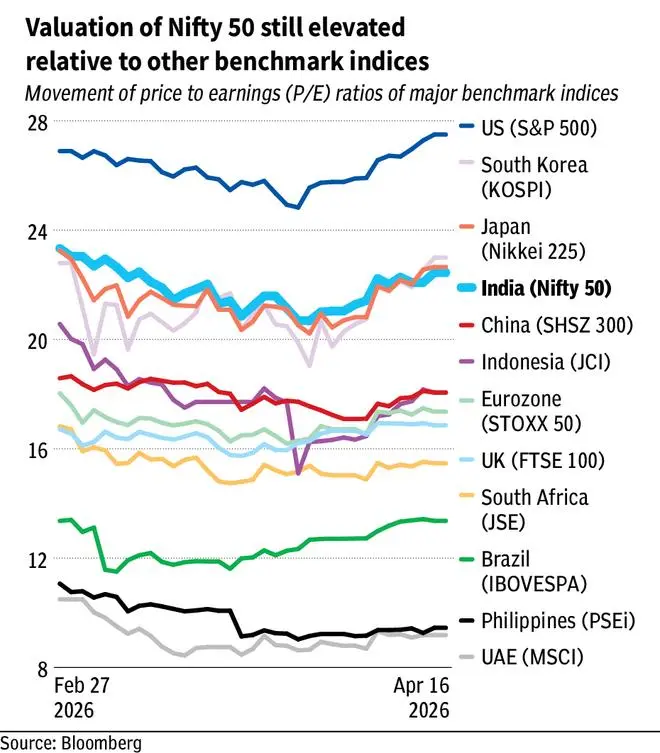
Despite this performance, the Nifty-50 is trading at a substantial premium compared to its emerging market counterparts.
Global Markets Under Pressure
The West Asia conflict has produced varied impacts across global equity markets. For instance, emerging market indices such as the United Arab Emirates’ MSCI index, which declined by 7.6%, and South Africa’s JSE index, down by 7.1%, reflect the negative consequences of proximity to the conflict zone and sensitivity to global trade dynamics.
Other nations such as Indonesia, whose benchmark index fell by 7.4%, and the Philippines, with a decline of 8.3%, have suffered significant setbacks due to their heavy reliance on West Asia for energy and other resources.
While India faces risks tied to trade disruptions, strong domestic investor engagement, particularly through mutual funds, has buoyed stock performance following the lows seen in late March. As a result, the Nifty-50 recorded a relatively modest loss of 3.7% during the conflict. Similarly, South Korea, benefiting from substantial petroleum reserves, has maintained some investor confidence, reflected in a milder decline of 2.4%.
Valuation Comes at a Premium
Currently, the Nifty-50 is trading at significantly elevated valuation levels compared to its emerging market peers. With a price-to-earnings (P/E) ratio of approximately 22.4, India surpasses countries like China, which has a P/E of 18, Brazil at 13.4, the United Arab Emirates with about 9.2, and the Philippines at roughly 9.4.
This premium valuation raises concerns regarding sustainability, as high valuations suggest that anticipated growth is already factored into stock prices, leaving little room for missteps. A shift in macroeconomic conditions, disappointing earnings, or a general risk-off sentiment could potentially trigger sharper corrections in this richly valued market.
Roshan Flavian is an intern.
Published on April 16, 2026