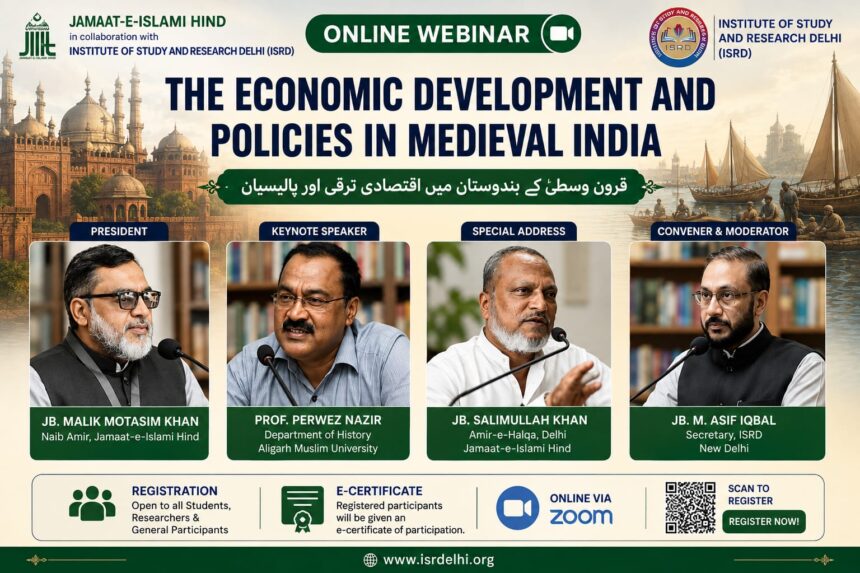

New Delhi: A recent webinar titled “Economic Development and Policies in Medieval India” highlighted how India’s medieval economy, particularly during the Sultanate and Mughal periods, marked a significant historical legacy. The discussions emphasized agriculture, irrigation, textiles, handicrafts, and trade, positioning India as a robust economic powerhouse of its time. However, it also serves as a crucial reference point for understanding historical narratives used in contemporary discussions about economic conditions and social exclusion faced by Muslims in modern India.
Contextualizing Medieval Economic Success
The webinar, organized by the Institute of Studies and Research Delhi (ISRD) and chaired by Jamaat-e-Islami Hind (JIH) Vice President Malik Moatasim Khan, brought together scholars to analyze various dimensions of medieval India’s economy. Professor Perwez Nazir of Aligarh Muslim University delivered a rich lecture, focusing on the economic policies of the Sultanate and Mughal periods. His examination included notable developments like Alauddin Khalji’s rationing system and Sher Shah Suri’s land classification, which were pivotal for laying a foundation for economic prosperity.
During this period, agriculture was the backbone of the economy, and trade, especially in textiles and handicrafts, flourished. Professor Nazir emphasized how these sectors not only provided goods for domestic needs but also contributed to substantial foreign trade. For instance, at its zenith, India accounted for approximately 25 percent of global GDP during Aurangzeb’s reign, illustrating its economic prowess.
Contemporary Issues: A Shadow of Past Prosperity
Despite the historical economic achievements of medieval India, the present-day scenario for Indian Muslims tells a more sobering story. Under the now predominantly Hindu nationalist government led by the Bharatiya Janata Party (BJP), there are rising concerns about the economic marginalization of Muslims. This discrimination manifests in social exclusion and economic boycotts, evidenced by targeted policies that inhibit the growth of Muslim-owned businesses and limit their participation in public life.
Malik Moatasim Khan, in his presidential address, emphasized that while the medieval period was marked by significant achievements, many contemporary Muslims face persistent challenges like poverty, unemployment, and social isolation. This growing disparity is exemplified in the agriculture sector, which employs nearly 46% of India’s workforce but only accounts for 18% of the national Gross Value Added (GVA). Such economic realities underscore a systemic issue: despite significant contributions to the economy, marginalized groups face substantial barriers in accessing opportunities.
The Role of Historical Narratives in Contemporary Politics
The historical successes of medieval Muslim rulers are sometimes overshadowed by a narrative that paints their era as one of darkness and oppression. This interpretation often serves political interests in modern India, coinciding with a rise in anti-Muslim sentiment fueled by the BJP and affiliated groups. Such narratives simplify complex histories and can exacerbate existing social divides.
For instance, historical achievements in agriculture and trade under rulers like Tipu Sultan, who promoted systematic economic management and infrastructure development for trade, are frequently overlooked. Instead, the political discourse sometimes focuses on past grievances like the jizya tax, further entrenching societal divisions. This approach can alienate younger generations from their rich historical heritage and undermine social cohesion.
Why It Matters
Understanding the complexities of medieval India’s economy and its implications for contemporary social dynamics is crucial in addressing modern issues of discrimination and social justice. It highlights the importance of inclusive economic policies that benefit all citizens, regardless of religion. While historical narratives can influence present policies, they can also create opportunities for dialogue and understanding among diverse communities, ultimately contributing to a more equitable society.
Frequently Asked Questions
What were the key features of the medieval Indian economy?
The medieval Indian economy was characterized by robust agricultural production, extensive trade networks, and thriving handicrafts and textile industries that catered to both domestic and international markets.
How does the historical economic success relate to today’s issues for Muslims in India?
Despite a rich historical legacy, contemporary Indian Muslims face economic and social challenges due to systemic discrimination, marginalization, and exclusion from opportunities that limit their participation in various economic spheres.
What is the significance of agricultural practices in medieval India?
Agriculture served as the backbone of the medieval Indian economy, with advancements in irrigation and land management playing critical roles in economic stability and growth during that period.
How are historical narratives influencing the current perception of Muslim contributions in India?
Historical narratives that highlight grievances or downplay achievements can lead to social exclusion and discrimination, affecting how Muslim contributions to Indian society are perceived today.