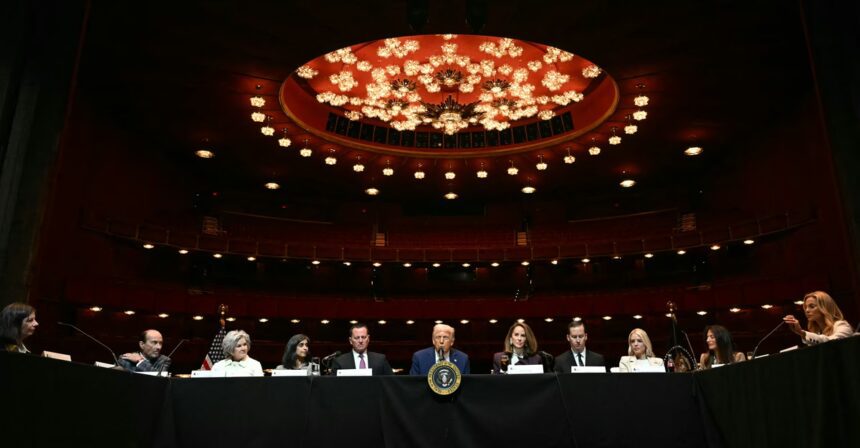

The ongoing legal saga surrounding the John F. Kennedy Center for the Performing Arts in Washington, D.C., has taken a dramatic turn with repeated attempts to honor former President Donald Trump. Key decisions by the board of trustees, which features Trump’s allies, have sparked lawsuits, public outcry, and concerns about the leadership’s direction amidst a significant institutional crisis.
The Governance Crisis at the Kennedy Center
The legal battles at the Kennedy Center highlight a troubling governance model that has recently attracted scrutiny. After Trump’s allies voted to rename the center after him, U.S. District Judge Christopher Cooper ruled that the board exceeded its authority, which has thrown the center into turmoil. This predicament has raised questions about whether the board’s decisions, largely influenced by Trump’s interests, are serving the center’s cultural mission or damaging its reputation. Critics argue that the board lacks the necessary engagement and expertise to navigate such complex issues effectively.
Unresolved Legal Battles and Fallout
As legal challenges continue to unfold, the Kennedy Center’s board is stuck in a cycle of litigation that appears to have no end in sight. After Trump’s allies on the board opted to reopen discussions on a plan to renovate and honor the former president, the ongoing lawsuit led by Democrat Joyce Beatty has created further complications. The looming possibility of a two-year closure for renovations poses a severe threat to the Kennedy Center’s operational integrity and financial viability, exposing a failure in governance that has perhaps alienated artists and donors alike.
A Shadow Over Artistic Integrity
The fallout from Trump’s takeover has raised significant concerns about the artistic integrity of the Kennedy Center. With purges reportedly stripping the institution of its institutional memory and leading to compromised staffing levels, the center risks losing its status as a premier cultural hub. Critics argue that the center’s brand has become so controversial that it may require a complete overhaul, potentially even a temporary shutdown to reassess its mission and leadership direction. The ongoing saga appears to be sowing distrust among artists, donors, and patrons.
Why This Is Trending
Indians are currently searching for information about the Kennedy Center controversy and its implications for the arts in the U.S., as international politics increasingly influence cultural institutions globally. The focus on Trump’s actions has drawn parallels to challenges facing governance in other countries, including India. Furthermore, as people become more aware of the intersection between politics and the arts, there is growing interest in how leadership decisions can affect cultural legacies. This case serves as a reminder of the critical role governance plays in maintaining not just national but global cultural transparency and integrity.
Frequently Asked Questions
What is the current status of the Kennedy Center’s renovations?
Ongoing legal battles have delayed any renovations at the Kennedy Center, with a recent ruling indicating that a new plan to honor Trump may also face challenges in court.
Why are critics concerned about Trump’s influence on the Kennedy Center?
Critics are concerned that Trump’s influence has resulted in governance focused on partisan interests rather than the center’s cultural mission, leading to potential damage to its reputation and financial health.
What could be the consequences if the Kennedy Center shuts down temporarily?
A temporary shutdown might allow the institution to reassess its mission but could also risk losing audiences, ticket sales, and vital relationships with artists and donors.
How can Congress intervene in the Kennedy Center’s governance issues?
Congress has the authority to change the governance structure of the Kennedy Center or update laws that dictate board decisions, but such legislative action seems unlikely at present.