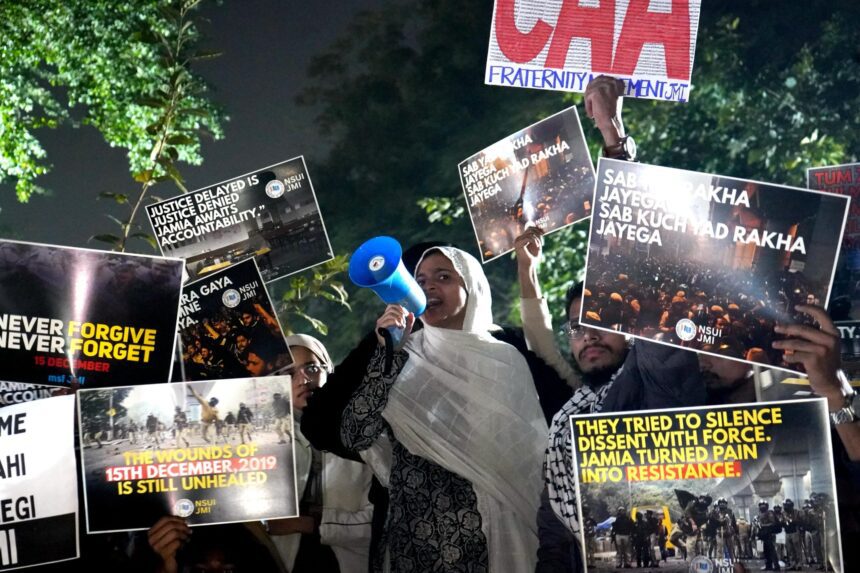
More than 500 students gathered inside the Jamia Millia Islamia university to commemorate the anniversary of the December 15, 2019 violence, when police and paramilitary forces entered Jamia’s campus, fired tear gas, beat students and vandalised property, including the Zakir Hussain Library. The crackdown left several students grievously injured, with at least one losing his eyesight permanently.
This year’s commemoration unfolded under strict policing. Barricades were erected outside Gate No. 7, identity cards were checked repeatedly, and police personnel remained stationed across the campus—an atmosphere many students described as a reminder that the events of 2019 were not an aberration, but a turning point.
Students marked December 15 as a “Resistance Day,” emphasising that the memory of the violence continues to shape political consciousness on campus.
“The police didn’t just attack bodies that night, they attacked the idea of dissent,” said Nausheen Farooque, General Secretary of the Fraternity Movement at Jamia.
Addressing the gathering, she recalled that the protests had begun in the women’s hostel, led by students such as Shahean Abdullah, Minhaj Ayesha Renna and Ladeeda Farzana. “One student lost his eyesight. Promises were made, but justice never followed,” she said.
Nausheen said, “We will never be able to erase that memory all our lives. It is etched in our mind as the black day.”
“University was the safest place for us, after our home. But the day we were treated as criminals at our own university changed everything for us”, she said while speaking to Maktoob.

She demanded compensation for victims and the release of student activists still imprisoned in cases linked to the anti-CAA movement, arguing that selective arrests have been used to intimidate an entire generation.
For many, the memory of December 15 is inseparable from trauma and identity.
A former Jamia student, Faiz (name changed on request), who witnessed the violence firsthand, described the night as one that permanently altered his life.
He recalled being assaulted shortly after offering evening prayers inside the campus. “The violence was not random. It targeted who we are,” he said, alleging that communal slurs were hurled as students were beaten.
“The trauma is linked to my Muslim identity,” he said. “That night shaped my politics.”
He questioned why similar police action was carried out at Jamia Millia Islamia and Aligarh Muslim University, but not at other universities. “When dissent comes from Muslim institutions, students are doubly vulnerable,” he said.
Beyond memory, Faiz raised concerns about the present, particularly surveillance. He pointed to the installation of facial recognition cameras at key campus locations, including the central canteen and other major spots on campus, alleging that students are now under constant monitoring.
“Students don’t know who has access to this data or how it will be used,” he said, adding that the surveillance has intensified fear and discouraged participation.
That fear, students said, is visible in declining turnout and shrinking voices. While protests continue every year, fewer students are willing to speak publicly.
“The repression didn’t end in 2019,” said Faiz. “It became more strategic.”
He cited the long incarceration of activists like Sharjeel Imam as an example. “The state doesn’t arrest hundreds. It arrests a few and keeps them behind bars for years to send a message.”
According to organisers, most speakers at protests now belong to student organisations, while unaffiliated students, despite facing discrimination and profiling, choose silence.
“Not everyone can afford activism,” said one of the organisers, pointing to the legal, financial and academic risks faced by students, especially those from marginalised backgrounds.
The protest began at the central canteen and culminated in a march around the campus, stopping outside the Zakir Hussain Library, one of the epicentres of the 2019 violence. Students chanted slogans and sang resistance songs, asserting that collective memory itself has become an act of defiance.
“The library stands as a witness,” a student kept recalling during the protests. “They tried to silence us here.”
The post JMI students gather to mark six years since police violence on anti-CAA protesters appeared first on Maktoob media.