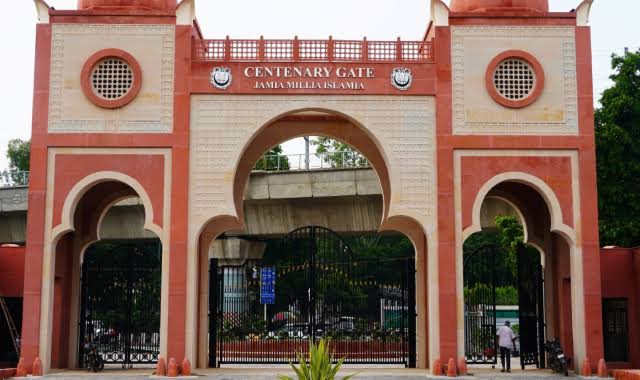
Students of the Department of Social Work at Jamia Millia Islamia have issued a strong statement expressing solidarity with Prof. Virendra Balaji Shahare, who was suspended by the university administration over an end-of-semester examination question asking students to “discuss the atrocities against Muslim minorities in India,” calling the action an “erosion of academic freedom and intellectual autonomy, and an impermissible narrowing of scholarly discourse.”
In their statement, the students asserted that the professor had committed “no wrongdoing” and maintained that the question cited as the basis for complaints was fully aligned with the prescribed syllabus. They said the syllabus explicitly mandates critical engagement with issues such as marginalisation, discrimination, violence, and structural injustice, and added that a copy of the syllabus was attached to their statement to substantiate the claim.
“Penalising an academic for facilitating critical engagement undermines the very foundation of social science education,” the students said.
The students argued that Jamia formally offers courses in Dalit and Minority Studies, Social Inclusion, Human Rights, and Social Justice, disciplines that are premised on critical inquiry and structural analysis. In this context, they said, the action against Prof. Shahare represents an erosion of academic freedom and intellectual autonomy, and an impermissible narrowing of scholarly discourse.
The statement strongly criticised the university’s invocation of Statute 37(1) to suspend the professor, calling it “arbitrary, excessive, and legally untenable.”
According to the students, the statute allows suspension only in exceptional circumstances involving prima facie evidence of grave misconduct, and solely as a temporary measure pending inquiry.
They maintained that setting an examination question approved through institutional mechanisms does not amount to misconduct, negligence, or “unbecoming conduct” under the statute.
Highlighting that examination papers undergo multiple levels of moderation and approval, the students questioned why only Prof. Shahare had been singled out.
“No questions have been raised against moderation committees, departmental vetting processes, or the Controller of Examinations, who bears statutory responsibility for the conduct of examinations,” the statement said.
The students also raised concerns about caste-based discrimination, noting that Prof. Shahare is a Dalit academic, stating, “The suspension reflects a disturbing pattern where individuals from marginalised communities bear the brunt of punitive action, while systemic accountability is evaded,” they alleged.
The students described the reported mention of filing a police FIR against the professor as a “dangerous and unjust escalation,” warning that it could set a precedent for criminalising pedagogy.
“Academic disagreements or public discomfort cannot and must not be converted into criminal liability,” the statement said.
The students demanded immediate and permanent revocation of Prof. Shahare’s suspension, withdrawal of any legal action, a public apology from the university, assurances against scapegoating faculty from marginalised communities, and a reaffirmation of Jamia’s commitment to academic freedom and constitutional values.
“We stand with our professor.
We reject this injustice.
And we will continue to speak until it is corrected,” they asserted.
Similarly, students of the Department of Political Science at Jamia Millia Islamia condemned the suspension and demanded its immediate revocation, stating that “institutions of higher learning must address internal disagreements through transparent, proportionate, and procedurally fair mechanisms.”
The students warned that such action affects not only the faculty member concerned but also the academic environment and students’ right to a free and critical learning space, adding that dialogue, not punitive measures, must remain the guiding principle of university governance.
Virendra Balaji Shahare, was the paper setter for the BA (Hons) Social Work Semester-I examination titled Social Problems in India for the academic session 2025–26.
The suspension comes after Prof. Shahare included a question asking students to “discuss the atrocities against Muslim minorities in India” in the examination paper he set, sparking outrage among students, fellow teachers, and rights groups/
The university stated that it had received several complaints from various sources regarding the content of the question paper.
In its order dated December 23, 2025, the university stated that the competent authority had taken a “serious view” of what it described as the professor’s negligence and carelessness. Acting on the instructions of the competent authority, Jamia said Prof. Shahare had been placed under suspension pending further orders.
The Jamia Millia Islamia unit of the Fraternity Movement has demanded the revocation of the teacher’s suspension, calling it a move to defend academic freedom.
The order further stated that a police FIR would be filed “as per rules” in connection with the matter.
Invoking Statute 37(1) of the Statutes of the University, the Vice-Chancellor ordered disciplinary action, stating that the alleged negligence amounted to an act “unbecoming” of a faculty member.
Earlier, several student organisations, including AIDSO, AIMSU, AIRSO, AISA, DISSC, MSF, the Fraternity Movement, SFI, and SIO, in a joint statement condemned the suspension, stating that the examination question asking students to “discuss the atrocities against Muslim minorities in India” was clearly syllabus-based and academically legitimate.
They called the university’s decision to suspend him and file a police FIR an unprecedented, disproportionate, and dangerous attack on academic autonomy, democratic functioning, and Jamia’s historical legacy of critical inquiry. They also demanded the immediate revocation of the suspension and withdrawal of all punitive proceedings.
The post Jamia students back Dalit Professor suspended over exam question on atrocities against Muslims appeared first on Maktoob media.