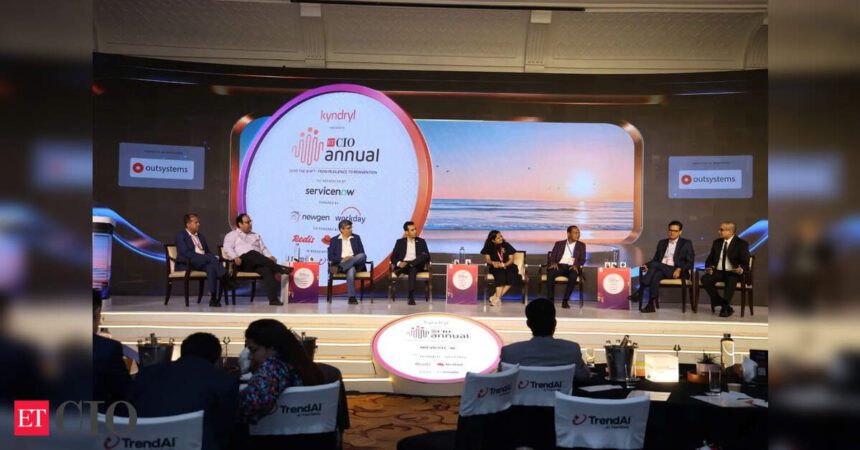

Industry 5.0 is emerging as a shift from traditional automation to human-centric manufacturing, emphasizing the augmentation of workforce capabilities with AI, connected systems, and real-time intelligence, according to industry leaders at the ETCIO Annual Conclave 2026. With geopolitical disruptions, supply chain volatility, and sustainability challenges reshaping priorities in manufacturing, businesses are increasingly focusing on adaptability, resilience, and human-machine collaboration across their operations.
The discussion during the conclave, entitled “From Smart to Human-Centric: Is Industry 5.0 Finally Reshaping Manufacturing?”, was moderated by Gautam Srinivasan, Senior Journalist & Consulting Editor at ETCIO.
Sandeep Gupta, Chief Digital and Information Officer of Cairn India Oil & Gas (Vedanta), emphasized that Industry 5.0 represents a transformative mindset rather than a mere technological shift. He stated, “Industry 5.0 is more of a mindset shift rather than a technology shift, because we want to have human-centricity, resilience, and sustainability together with output.”
Gaurav Gulati, Group CIO at Motherson Group, noted that while Industry 4.0 primarily concentrated on machine optimization and automation, Industry 5.0 focuses on enhancing human-machine partnerships. He articulated that recent disruptions have underscored the necessity for adaptability, which remains fundamentally human-centered, even as AI enhances decision-making processes.
Vishal Gupta, Head of Business Transformation and Digital for India and SAARC at Godrej Consumer Products, described Industry 5.0 as an evolution of Industry 4.0. He indicated that businesses are integrating layers of resilience and sustainability into their automation initiatives while prioritizing workforce experience in their industrial transformation.
The panel underscored how AI and connected systems are democratizing operational decision-making. Prashant Arora, Senior Director of Strategy and Transformation at PepsiCo, remarked, “Industry 5.0 is about augmented intelligence and putting decisions at the forefront instead of the backend.” He explained that frontline workers are now empowered with straightforward data and AI-driven insights, reducing dependency on supervisory oversight.
Technology providers on the panel highlighted that Industry 5.0 extends beyond smart factories into predictive and autonomous industrial ecosystems. Sridhar Durairajan, AVP of Solution Sales at ServiceNow, pointed out that manufacturing systems are evolving into interconnected environments where AI can predict disruptions, schedule proactive maintenance, and automate workflows to prevent failures.
Ravinder Singh, Country Director for Enterprise and Government at HPE Networking India, mentioned that the transition to Industry 5.0 is heavily dependent on infrastructure readiness and data quality. He warned that AI-driven manufacturing initiatives might falter not due to inadequate AI models but because of underdeveloped network and connectivity layers that cannot support real-time operations at scale.
The panel frequently returned to workforce transformation as a crucial factor in facilitating the adoption of Industry 5.0. Gupta shared an example from Cairn India’s digital twin implementation, noting initial challenges due to operator skepticism towards system-generated recommendations. “You need to upskill humans and bring their intelligence into the system. It cannot just be a closed-loop system,” he asserted.
The conversation also encompassed the growing interplay between productivity, sustainability, and operational responsibility. Gupta noted that these elements can no longer be treated in isolation, with Arora adding that effective change management is becoming a defining aspect of Industry 5.0 initiatives.
As companies transition from experimental projects to broader adoption, the panel reached a consensus that future manufacturing transformations will hinge less on isolated technologies and more on developing scalable capabilities, digitally adept workforces, and robust operational bases. The clear agreement across the discussion was that Industry 5.0 will not displace humans with machines but will increasingly depend on amplifying human intelligence through AI.
(With inputs from Sachi Srivastava)
Published On May 22, 2026, at 08:03 AM IST