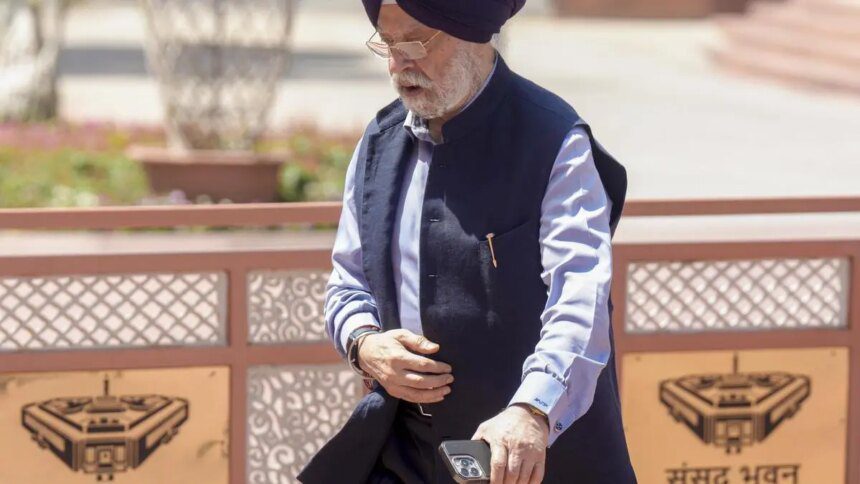

India, with a two-month supply of fuel stocks, faces no immediate supply concerns, even amidst global energy supply disruptions, according to Oil Minister Hardeep Singh Puri. However, he warned that state-run fuel retailers could incur losses of up to ₹1 lakh crore in a single quarter if crude prices remain high and retail prices do not rise.
Puri emphasized the need for a reassessment of how long retailers can sustain losses from selling petrol, diesel, and cooking gas (LPG) below their cost. While he refrained from predicting if prices would increase soon, he acknowledged the growing fiscal pressure from keeping retail fuel prices stable.
At the CII’s Annual Business Summit, Puri stated, “We have no supply-side problems,” highlighting that India commenced this crisis with an ample inventory of crude oil and LPG. The country has also increased domestic LPG production from 36,000 tonnes per day to 54,000 tonnes.
Despite the ongoing crisis, state-owned oil marketing companies (OMCs) have ensured continuous supply at prices significantly lower than costs, unlike many global energy systems that have resorted to rationing or steep price hikes. The three OMCs—Indian Oil Corporation (IOC), Bharat Petroleum Corporation Ltd (BPCL), and Hindustan Petroleum Corporation Ltd (HPCL)—are currently experiencing record-high under-recoveries, which total approximately ₹1.98 lakh crore for the current quarter.
Puri indicated that cumulative losses could potentially wipe out the annual profits of these oil companies. He expressed concern over how long the companies could absorb these losses, stating, “My oil companies are losing ₹1,000 crore a day.”
Fuel prices have remained unchanged for four years, with petrol priced at ₹94.77 per litre and diesel at ₹87.67 per litre, despite a 50% increase in crude oil prices. Cooking gas prices were increased by ₹60 per cylinder in March, but remain substantially lower than the actual cost.
Puri referred to Prime Minister Narendra Modi’s call for moderation in energy consumption as a “visionary” approach rather than an impending signal for restrictions. “It’s not that any lockdown is going to happen tomorrow,” he said, stressing the need to consider measures to reduce fiscal strain if these disruptions continue.
He encouraged industries and households to transition from LPG to piped natural gas (PNG) where feasible, asserting that India is rapidly expanding pipeline infrastructure and liquefied natural gas (LNG) availability. “We have no shortage of pipe gas,” Puri stated, noting that it is cleaner, cheaper, and supports the energy transition.
Following the current crisis, the government is reassessing its strategic energy storage policies to address vulnerabilities in global supply chains. Puri indicated that India would need to build larger reserves over time, saying, “The experience since February 2026 means you have to rethink everything.”
Modi also urged for fuel conservation as rising global energy prices are affecting India’s foreign exchange reserves, along with suggestions for restraint in gold purchases to mitigate external vulnerabilities. “There are activities which we can curtail,” Puri emphasized, while reassuring that there is no cause for anxiety over supply shortages.
Puri noted that India’s handling of the situation has been commendable, as the country has swiftly replaced previously imported Gulf supplies without disruptions. “Every petrol pump in the country has had petrol and diesel. LPG supply is more than enough,” he asserted, debunking narratives of shortages.
India has maintained stable fuel prices over the past four years despite global shocks, a feat not observed among other major energy-importing economies. He challenged, “Tell me one country where prices have remained the same, and there has been no shortage anywhere.”
As global crude prices continue to rise amidst geopolitical tensions, Puri confirmed that India holds around 60 days of crude oil supplies, 60 days of LNG inventories, and 45 days of LPG reserves, stating there is “absolutely no cause for anxiety.” Fuel demand remains resilient during the crisis, with petrol consumption increasing by around 6%, while LPG demand has moderated to approximately 75,000 tonnes per day from nearly 90,000 tonnes previously.
Refiners have enhanced LPG output while supplementing supplies with kerosene and biofuels, effectively reducing reliance on imported cooking gas. Puri remarked, “We are no longer import-dependent on our refineries, and that is where our strength has come from.”
India aims to expand its refining capacity to 320 million metric tonnes annually by 2030, establishing the country as a major refining hub. Puri also indicated a more aggressive push toward domestic oil and gas exploration, stating that the government has made amendments to exploration rules and increased outreach to global oil companies.
Published on May 12, 2026.