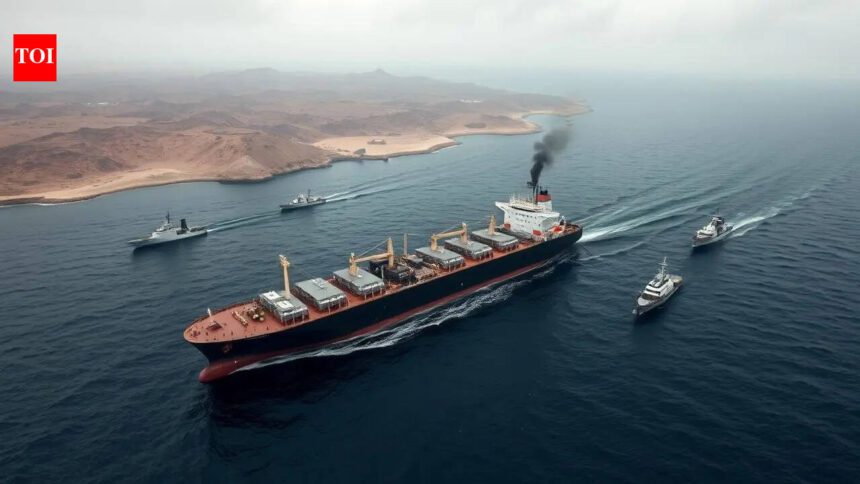

NEW DELHI: Iranian gunboats fired upon two Indian-flagged tankers that were forced to retreat from the Strait of Hormuz on Saturday. Nonetheless, the tenth Indian-flagged tanker, Desh Garima, successfully navigated the strait while carrying crude oil to Mumbai port. Iran has intermittently allowed Indian vessels to pass through the strait since it began blocking the critical energy route last month amid ongoing hostilities with the United States and Israel that commenced on February 28.
Maritime Traffic data indicates that numerous Indian and foreign-flagged ships remain awaiting passage through the Strait of Hormuz. Official reports indicate that 13 Indian vessels are currently located in the Persian Gulf (west of Hormuz), six in the Gulf of Oman (east of Hormuz), one in the Gulf of Aden, and three in the Red Sea. The Ministry of Petroleum has identified 17 vessels for evacuation, which encompasses four LPG carriers, three LNG carriers, and 10 crude oil tankers; of these, three are Indian-flagged, while the remainder are foreign-flagged. In addition, the Ministry of Chemicals and Fertilizers has compiled a list of another 16 ships for evacuation, including an Indian-flagged vessel, Jag Arnav, which was attacked by the Iranian Revolutionary Guard Corps (IRGC) on Saturday.
As of Saturday, there are 499 Indian seafarers aboard Indian-flagged vessels in the Persian Gulf region—343 west of the Strait of Hormuz and 156 in the Gulf of Oman. To date, shipping companies have managed to evacuate 2,487 seafarers.
According to a report from Reuters, vessels attempting to navigate the Strait of Hormuz received radio communications from the Iranian navy declaring that passage was prohibited, with two ships reporting being struck by gunfire. Several commercial vessels attempted to transit the strait following a notice to mariners issued a day prior, indicating that passage was permitted but would be confined to lanes that Iran deemed secure.