A Viral Incident Sparks Controversy
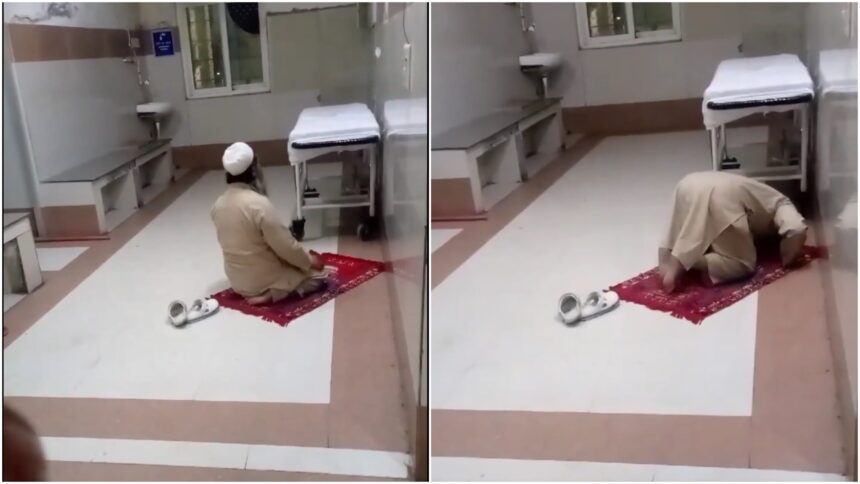
A video showing a Muslim man offering prayers, or Namaz, inside a government hospital in Firozabad, Uttar Pradesh, has gone viral, drawing significant attention and critiques from Hindutva extremists. This incident has sparked a debate over religious freedom and public space, as although Namaz typically takes no more than 20 minutes, it has become a flashpoint for communal tensions.
Political Reactions and Controversial Statements
In the wake of the incident, BJP MLA Ketki Singh made a highly controversial statement suggesting that a separate ward be designated for Muslims within the hospital. She stated, “Muslims have a problem with Hindu festivals like Holi, Ram Navami, and Durga Puja. Probably they also have a problem getting their treatment done along with Hindus. I will request Maharaj ji, Chief Minister Yogi Adityanath, to allocate a separate ward for Muslims so that they are treated separately.” Singh’s remarks have been met with widespread criticism from various sections of society who accuse her of fueling divisive narratives.
Reports indicate that Singh expressed concerns regarding safety, stating, “Who knows what will happen if they spit on us? We must ensure our safety.” This has alarmed many who believe such rhetoric serves to propagate animosity and intolerance against the Muslim community.
Support for Extremist Views
Many right-wing organizations have rallied in support of Singh’s remarks, claiming that the offering of prayers in the hospital was an intentional display of religious dominance. Hindu Vahini leader Hridesh Sharma criticized the incident, asserting that, “The administration has passed a rule that no new practice should be started. Offering prayers within the premises is unacceptable.”
Adding to the controversy, the hospital management has also sided with these groups. Chief Medical Superintendent Dr. Naveen Jain confirmed that an investigation is underway to ascertain the identity of the individual praying and the staff present during the incident. He remarked, “Namaz should be offered in a mosque,” thereby supporting the narrative that spaces should be segregated based on religious practices.
Diverse Public Reactions
The incident has elicited a wide range of reactions across social media platforms, with many users expressing shock at the characterization of a religious practice as an “attempt to prove dominance.” Critics have raised concerns about the lack of infrastructure in hospitals and questioned the focus of political leaders, suggesting that instead of addressing systemic healthcare issues, the BJP is diverting attention by polarizing a routine situation into a religious conflict.
Users have pointed out that in a country as diverse as India, public spaces should accommodate different religious practices without fear of backlash or vilification. The outrage surrounding the incident reflects deeper societal fissures that are often manipulated for political gain.
Why This Matters
The Firozabad incident shines a light on the increasing polarization in Indian society, particularly concerning religious practices and communal relations. The reactions from politicians and organizations highlight a trend where routine acts of faith can become contentious and politicized. Such developments are critical for Indian readers to understand, as they not only affect community relations but also shape national policy and political narratives. The call for segregating hospital wards based on religion raises fundamental questions about equality, secularism, and the basic tenets of the Indian Constitution.
Frequently Asked Questions
What sparked the controversy in Firozabad’s hospital?
A Muslim man offering Namaz inside a government hospital led to widespread criticism from Hindutva extremists claiming it was an assertion of religious dominance.
What did BJP MLA Ketki Singh propose?
She controversially suggested allocating a separate ward for Muslims in the hospital, arguing that Muslims have issues with Hindu religious festivals and healthcare.
How did the hospital administration respond?
Chief Medical Superintendent Dr. Naveen Jain expressed that Namaz should be performed in a mosque and confirmed that an investigation is ongoing regarding the incident.
What are the implications of this incident?
The event signals rising communal tensions in India and raises significant questions regarding religious freedoms, equality, and public safety in diverse settings.