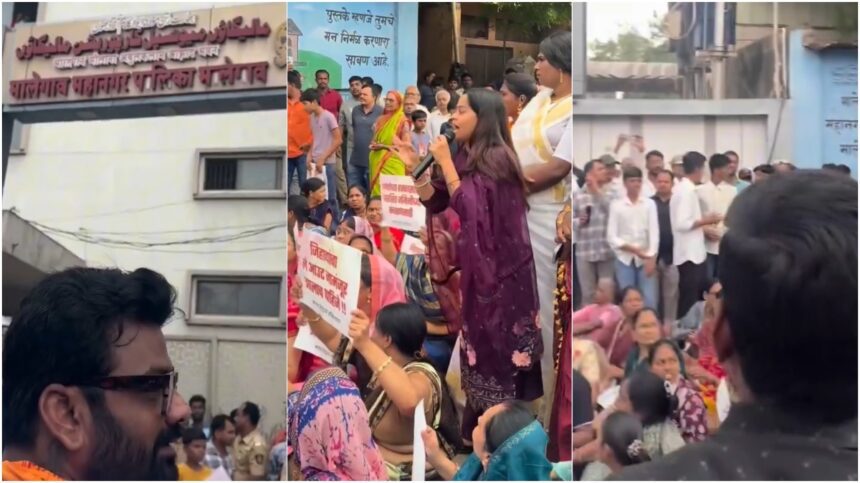
A recent protest in Malegaon, Maharashtra, led by the right-wing group Sakal Hindu Samaj, has sparked a significant debate over language rights in India. The demonstration called for the removal of an Urdu nameplate from the Malegaon Municipal Corporation building, which also features names in Hindi and Urdu. This incident illustrates the ongoing tensions surrounding language, identity, and constitutional values in India’s diverse society.
Protest Against Urdu Signage
The protest, termed Jan Aakrosh Morcha, focused on the Urdu nameplate of the Malegaon Municipal Corporation, named “Bharat Ratna Maulana Abul Kalam Azad Bhavan” in honor of the country’s first Education Minister and a prominent figure in India’s struggle for independence. Protesters, led by Harsha Thakur of Sakal Hindu Samaj, criticized the presence of Urdu signage. Thakur questioned, “Is Malegaon Pakistan? There is no provision in the Constitution for writing in Urdu.”
This statement underscores a growing sentiment among some groups that see the use of Urdu, an official language listed in the Eighth Schedule of the Indian Constitution, as unwarranted in certain regions. Thakur’s remarks reflect a broader narrative where linguistic minorities face scrutiny and stigmatization, particularly in states with significant non-Hindi speaking populations.
Social Media Backlash and Public Sentiment
The remarks made by Thakur triggered a strong backlash on social media, with many users defending the inclusion of Urdu. Critics pointed out that Urdu holds official status in several Indian states such as Uttar Pradesh, Bihar, and Telangana. The backlash highlighted that bilingual signage in areas with substantial Urdu-speaking populations is not merely an inclusive gesture but also a recognition of linguistic diversity enshrined in India’s Constitution.
Furthermore, supporters of the Urdu signage emphasized the need for an inclusive approach to governance that caters to the linguistic diversity of communities. In Malegaon, home to a large Urdu-speaking populace, many residents viewed the bilingual sign as a practical step toward ensuring accessibility and representation.
Maulana Abul Kalam Azad’s Legacy and Its Relevance
The protest has inadvertently brought renewed focus to the legacy of Maulana Abul Kalam Azad, a key figure in India’s independence movement and a champion of modern education. His contributions have often been overshadowed by contemporary political discourse, which increasingly marginalizes minority voices. Social media users have highlighted that Azad’s work laid essential foundations for an inclusive education system.
Supporters assert that Urdu is an Indian language, having evolved in India, forming an integral part of the country’s linguistic and cultural heritage. The current debate around Azad’s legacy serves as a reminder of the complexities of Indian identity and the challenges faced by linguistic minorities under political scrutiny.
Why It Matters
The incident in Malegaon reflects broader societal issues concerning language rights and the representation of minorities within Indian governance. It highlights the fragility of linguistic diversity in a nation where political narratives often privilege majoritarian languages. The response from communities and the government might set precedents for how language rights are respected in India, influencing public policy and societal attitudes toward inclusivity. The ongoing debate serves as an indicator of the state of democracy in the country, revealing tensions that could impact social cohesion and governance.
Frequently Asked Questions
What is the significance of Urdu in India?
Urdu is one of the recognized languages in India, included in the Eighth Schedule of the Indian Constitution, granting it official status in various states. It has a rich literary history and is widely spoken in regions with significant Muslim populations.
Who was Maulana Abul Kalam Azad?
Maulana Abul Kalam Azad was India’s first Education Minister and a prominent leader in the Indian independence movement. He played a crucial role in shaping modern Indian education and advocating for inclusive policymaking.
What impact does this protest have on language rights in India?
The protest underscores ongoing tensions regarding language rights and representation of minorities in India. It could influence public perceptions and government policies toward linguistic diversity and inclusivity.
How are protests like this received on social media?
Protests over language and identity often elicit strong opinions on social media. In this case, many users defended the use of Urdu, emphasizing the need for inclusivity and recognition of linguistic diversity, showcasing a divide in public opinion on these issues.