
Gaza Children Return to Classes After Years of Conflict
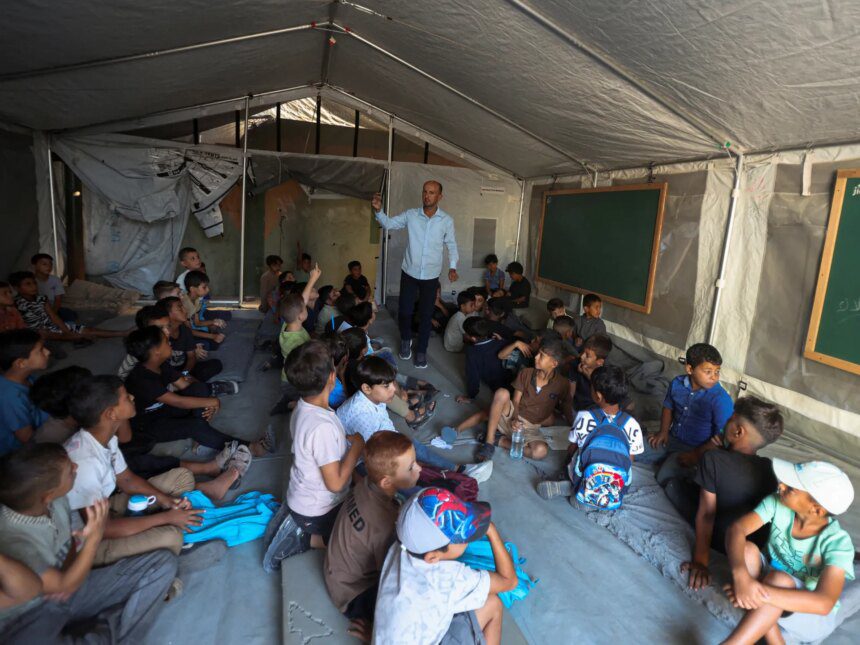
In a significant yet somber milestone, hundreds of thousands of children in Gaza returned to in-person classes for the first time in nearly three years. Despite the devastation caused by ongoing conflicts, these students are now attending classes in makeshift environments, illustrating the grim reality of educational deprivation and infrastructural decay in the region.
Devastation of Gaza’s Educational Infrastructure
According to the United Nations Children’s Fund (UNICEF), an alarming 98 percent of schools in Gaza have been either destroyed or severely damaged during the recent conflicts. Local education officials report that approximately 660,000 students have been denied regular education, highlighting a dire situation affecting the youth of this region.
Amid this backdrop, Ibrahim Ramadan, the director of education for eastern Khan Younis, provided sobering statistics: around 22,000 students and over 770 education workers have lost their lives to the violence, including 532 teachers. The reopening of schools, albeit in challenging conditions, marks a crucial step towards normalcy in a territory deeply scarred by loss and trauma.
Challenges in the Learning Environment
The enthusiasm for returning to school is palpable, even among students who face tremendous hardships. “The last time I have been to school was three years ago,” expressed Moayed Abu Mustafa, a student in Khan Younis. Despite having no proper shoes or learning materials, he commented, “it is a year of joy, happiness and success. We will learn, even in a tent.”
The Ministry of Education in Gaza, alongside aid agencies, has set up temporary schools using tarpaulins, sheet metal, and wood. Some of these classrooms are minimally equipped, with only a few mattresses and blackboards. Many still serve as shelters for displaced families, underscoring the depth of the humanitarian crisis.
Students like Samar Abu Salmi, a 15-year-old living in a tent, face further challenges. With soaring prices of school supplies due to Israeli import restrictions, even basic stationery has become unaffordable. Khaled Aliyan, a local stationery trader, noted that prices for these essential items have increased fivefold, exacerbating the difficulties faced by families trying to facilitate their children’s education.
Political Context and Ongoing Struggles
While the recent “ceasefire” declared in October 2025 has brought a halt to large-scale hostilities, underlying tensions remain unresolved. Israeli forces continue to control over 60 percent of Gaza, complicating the rehabilitation efforts further. The geopolitical landscape surrounding Gaza and its impact on education is a pressing concern that extends beyond its borders.
This situation bears relevance for India and other nations engaged in discussions about humanitarian support, regional stability, and the protection of educational rights. The growing need for international assistance in rebuilding infrastructure and providing educational resources becomes increasingly apparent.
What This Means
The resumption of in-person education in Gaza, despite the challenging conditions, serves as a poignant reminder of the resilience of children in conflict zones. For Indian readers, it highlights the importance of educational access as a foundational element for societal recovery. Furthermore, it encourages a broader understanding of humanitarian efforts and geopolitics affecting the region. The situation calls for renewed international attention and support to ensure that education remains a universal right, irrespective of circumstances.
Frequently Asked Questions
Why is the education system in Gaza so severely affected?
The education system in Gaza has been devastated due to ongoing conflicts, with 98 percent of schools either destroyed or damaged, resulting in significant educational disruption for hundreds of thousands of children.
What are the current conditions of classrooms in Gaza?
Many students are attending classes in makeshift schools made from tarpaulins and wood, with some classrooms featuring minimal facilities like a few mattresses and blackboards. Many of these structures also serve as temporary shelters for displaced families.
How have the conflict and restrictions affected school supplies?
Israeli import restrictions have led to a significant price increase in school supplies, with reports indicating that stationery items have become five times more expensive, making it difficult for families to afford basic educational materials.
What is the current political situation in Gaza?
Despite a ceasefire that halted large-scale fighting in October 2025, tensions remain high, with Israeli forces controlling a significant portion of Gaza. The situation continues to affect the humanitarian and educational landscape, necessitating ongoing international attention.