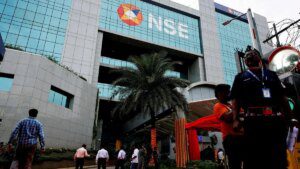

Foreign portfolio investors (FPIs) remained net sellers in Indian markets during the shortened trading week ending April 30, 2026, withdrawing a total of ₹13,944.59 crore across equity, debt, hybrid, and mutual fund instruments over four sessions—Monday through Thursday—due to market closure on Friday for Maharashtra Day.
The sell-off was predominantly focused on equities. According to data from the National Securities Depository Limited (NSDL), FPIs recorded net equity outflows of ₹8,721.65 crore on Monday, April 27, marking the steepest single-session sell-off of the week. On Tuesday, net equity outflows decreased to ₹4,188.34 crore, followed by ₹1,991.87 crore on Wednesday and ₹1,978.63 crore on Thursday, culminating in total net equity outflows of ₹16,880.49 crore for the week.
Despite the overall outflows, a moderating trend was evident across all asset classes combined. Net outflows decreased from ₹8,800.14 crore on Monday to ₹3,811.46 crore on Tuesday, then further to ₹1,112.37 crore on Wednesday, and sharply narrowed to ₹220.62 crore on Thursday. This suggests that while selling pressure persisted, its intensity was diminishing by week’s end.
The debt markets served as a partial counterbalance to the overall sell-off. Although FPIs were net sellers in some debt segments—especially the Fully Accessible Route (FAR) on Monday and Tuesday—they became net buyers in FAR on Wednesday (₹1,338.95 crore) and Thursday (₹1,257.01 crore). The Voluntary Retention Route (VRR) segment also experienced inflows on Monday (₹1,591.32 crore) and Tuesday (₹911.10 crore), with mixed results in general limit debt flows throughout the week.
Global factors contributed to the continued outflows. In April, FPIs sold a total of ₹63,167 crore while investing ₹2,319 crore through the primary market, resulting in net FPI outflows of ₹60,848 crore. According to Dr. V K Vijayakumar, Chief Investment Strategist at Geojit Investments Limited, total FPI outflows from India in 2026 thus far reach ₹1,91,968 crore. He noted a structural shift in foreign capital flow, with Japan, South Korea, and Taiwan seeing increased inflows, while India and other emerging markets grappled with outflows amid challenges like the energy crisis and currency depreciation. The ongoing AI trade, particularly benefiting semiconductor companies in South Korea and Taiwan, has also played a pivotal role in this trend.
Geopolitical concerns further compounded the situation. Renewed tensions surrounding the U.S.–Iran dynamics and rising crude oil prices affected market risk appetite, with the rupee hitting historic lows during the week. Dr. Ravi Singh, Chief Research Officer at Master Capital Services Ltd., highlighted that Brent crude surged over 7 percent week-on-week, nearing $114 per barrel, which raised inflationary anxieties. The rupee’s depreciation increased India’s import costs, further compressing risk appetite in the markets.
Despite the outflows, domestic institutional investors remained active, mitigating some of the market’s downward pressure. The Nifty 50 index concluded the week with a modest gain of 0.42 percent, closing at 23,997.55, while the BSE Sensex rose 0.33 percent, ending at 76,913.
Published on May 2, 2026.