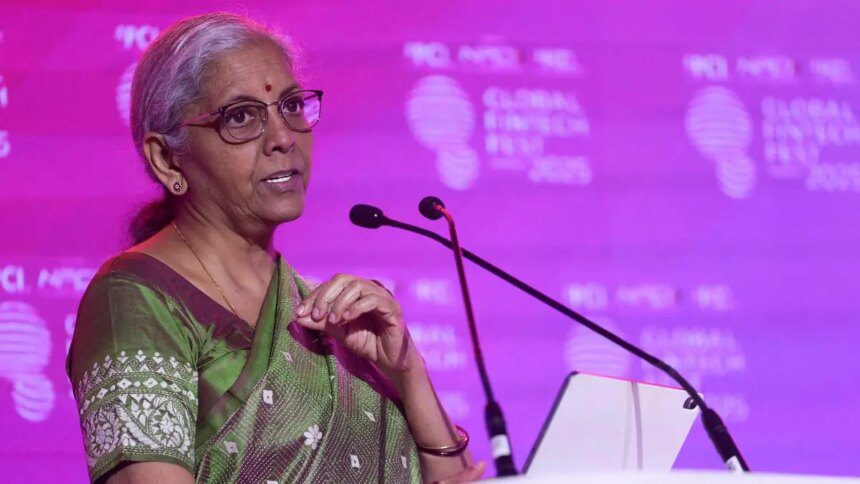

Union Finance Minister Nirmala Sitharaman on Saturday advocated for a more “sophisticated and anticipatory” regulatory approach to India’s capital markets during her address at the Securities and Exchange Board of India (SEBI)’s 38th Foundation Day. She urged SEBI to enhance investor trust in the face of rapid technological advancements and structural changes within the investment landscape.
Sitharaman emphasized the need for simplified, standardized, and digital Know Your Customer (KYC) processes across various financial sectors, directing SEBI to take the initiative in creating a smooth investor experience. She advocated for the development of deeper corporate bond markets, increased retail participation, and an enhanced focus on municipal bonds to support urban infrastructure financing.
Recognizing the evolution of Indian markets into one of the world’s most advanced ecosystems, she noted that the growing scale and complexity necessitate upgraded surveillance, cybersecurity preparedness, and investor protection measures. “Regulation should become more sophisticated and anticipatory rather than merely reactive,” she stated, reinforcing that trust and integrity are the “invisible infrastructure” of financial markets.
Highlighting SEBI’s accomplishments, the minister pointed to India’s early adoption of the T+1 settlement cycle, the pioneering application of ASBA (Application Supported by Blocked Amount) for initial public offerings (IPOs), and the implementation of UPI-based applications, all of which have significantly increased retail participation. In the financial year 2026, the primary markets recorded 366 IPOs that raised approximately ₹1.9 lakh crore, showcasing strong momentum in capital formation.
Sitharaman also noted SEBI’s impressive success rates at legal forums, with over 90% in the Supreme Court, 73% at the Securities Appellate Tribunal, and 92% at Civil Courts and the National Company Law Tribunal (NCLT), underscoring the robustness of its legal framework.
However, she cautioned that increasing retail participation must be accompanied by enhanced financial literacy. “Participation without understanding can create vulnerability,” she said, proposing that investor protection should evolve from a defensive to a developmental role.
Sitharaman raised concerns about emerging risks associated with unregistered “fin-fluencers,” deepfake-driven fraud, and AI-enabled cyberattacks, advocating for stricter enforcement and heightened public awareness. She called on SEBI to extend tools like ‘SEBI Check’ and to reinforce real-time monitoring systems.
Stressing the importance of global engagement, she expressed that Indian regulation must maintain dialogue with international counterparts to address cross-border risks and attract global capital, declaring, “India needs not just bigger markets, but better markets.” She highlighted that a deeper bond market should also prioritize the serious promotion of municipal bonds, pointing out that urban infrastructure financing cannot solely rely on budgetary resources.
Sitharaman concluded by stating that the journey towards a “Viksit Bharat” (Developed India) demands “extraordinary investment” in infrastructure, manufacturing, energy transition, urban transformation, innovation, and human capital, emphasizing that such investments cannot be financed solely through the public balance sheet or banks.
Published on April 25, 2026.