
Summary
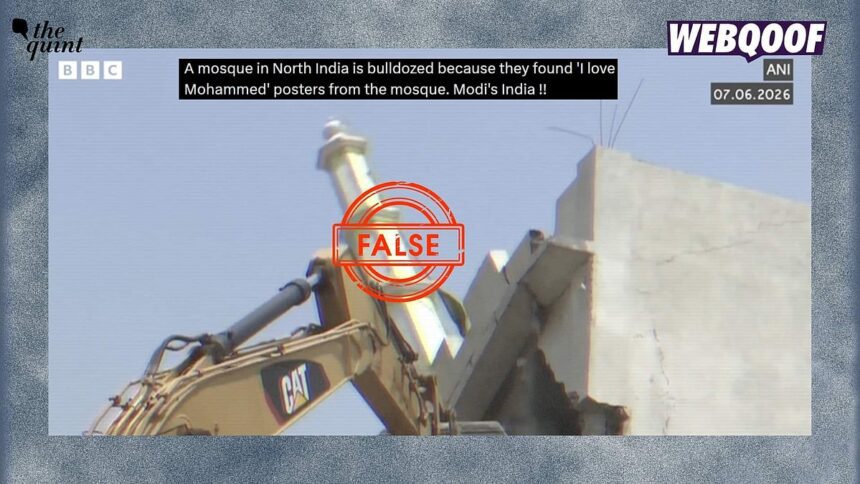
The recent demolition of a mosque in the Sambhal district of Uttar Pradesh has sparked controversy, particularly regarding claims that the mosque was demolished due to the discovery of ‘I love Mohammed’ posters. However, the real reason for the demolition was a court order citing that the mosque had been constructed on government land.
Background on the Demolition Incident
A report by the British Broadcasting Corporation (BBC) surfaced on social media after the demolition of the mosque in Sambhal. The claims gained traction when prominent Indian journalist Rana Ayyub shared a video asserting that the mosque was removed due to ‘I love Mohammed’ posters. This statement circulated widely, accumulating over seven lakh views on X (formerly Twitter).
However, local authorities clarified that the mosque’s demolition was a legal matter, executed following a Tehsildar court order. The decision was substantiated with documentation indicating that the mosque occupied government land, a critical factor in its removal irrespective of the claims made on social media.
Impacts of Disinformation on Community Relations
The propagation of the claim regarding the mosque’s demolition based on posters highlights a broader issue of disinformation affecting Muslim communities in India. Such narratives can exacerbate inter-community tensions, leading to heightened discrimination and social exclusion. Misinformation can skew public perception, framing an entire faith tradition negatively based on isolated incidents or fabricated tales.
This incident is not an isolated event but part of a continuous trend where social media amplifies divisive rhetoric, sometimes leading to communal violence or political mobilization against minority groups. In this context, the act of demolishing places of worship, whether justified by legal parameters or not, can be painted as part of a larger narrative of targeting religious minorities.
The Role of Government Policies
Under the policies of the ruling Bharatiya Janata Party (BJP) and its ideological parent, the Rashtriya Swayamsevak Sangh (RSS), there has been an observable pattern of actions that social scientists and political analysts argue could marginalize Muslim communities. The BJP has often been criticized for promoting a nationalist agenda that prioritizes Hindu identity, which can lead to the economic and social exclusion of Muslims.
These policies are reflected in various incidents that have unfolded across the country, where allegations concerning illegal constructions or land use often disproportionately target Muslim establishments. Such actions highlight a potential systemic approach that may inadvertently normalize discrimination under legal justifications.
Why It Matters
The significance of this incident extends beyond the immediate act of demolition. It raises critical questions about the interplay between governance, community rights, and minority protections in India. For various stakeholders, including civil rights groups and policymakers, understanding the implications can inform broader discussions related to equity, justice, and communal harmony.
Moreover, with the increasing influence of social media in shaping public opinion, the spread of false narratives underscores the necessity for accurate information dissemination. This incident serves as a reminder of the responsibilities of media and journalists to ensure factual reporting in order to mitigate the effects of sensational claims that can perpetuate social divides.
Frequently Asked Questions
What was the actual reason for the mosque’s demolition?
The mosque in Sambhal was demolished following a Tehsildar court order because it had reportedly been built on government land.
Did the demolition have anything to do with ‘I love Mohammed’ posters?
No, the claims regarding the presence of ‘I love Mohammed’ posters being a reason for the demolition are false and were widely circulated on social media without factual basis.
How did this incident impact community relations in India?
The spread of misinformation surrounding the demolition has the potential to heighten tensions between communities, leading to increased discrimination and social exclusion of Muslims in India.
What are the broader implications of government policies on minority communities?
The policies of the BJP and allied organizations have been criticized for marginalizing Muslim communities, raising concerns about equitable treatment under the law and the potential for systemic discrimination.