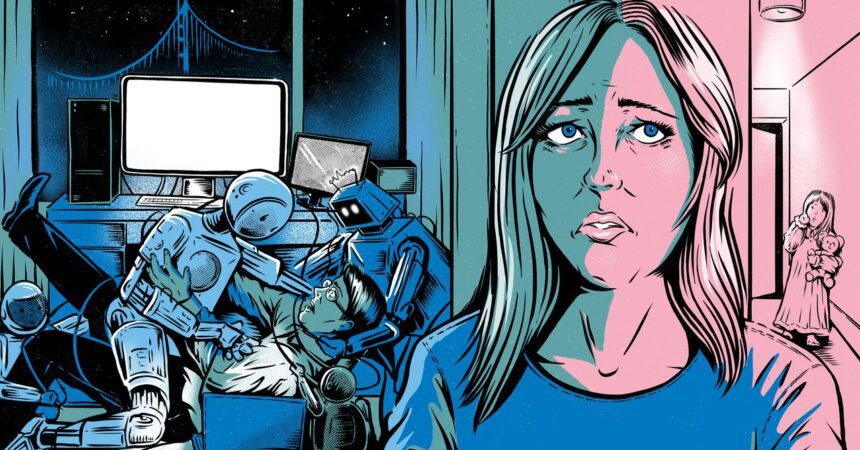

Some analyses indicate that women are about 20 percent less likely than men to utilize generative AI. According to Rodgers, this discrepancy is not inherently linked to gender but is largely influenced by the occupations women hold. Women are often found in fields such as education, health care, and social services, which currently utilize AI to a lesser extent. This situation could lead to a cumulative disadvantage, resulting in less access to financial rewards associated with the AI boom and an increased burden of domestic labor created by these advancements.
The volatility of the AI sector raises concerns about job stability for men involved in this field. Rodgers notes that job loss can lead to depression, which affects household dynamics. When one partner experiences adverse mental health effects due to job uncertainty, the other partner often assumes the role of a support system. Ironically, if a husband exits the AI sector, whether voluntarily or involuntarily, it may add stress to the household. His increased presence at home could exacerbate emotional struggles, ultimately increasing the responsibilities of his partner.
In a recent therapy session, one woman reflected on her feelings of mental overload, including hormonal changes and postpartum depression. When her therapist inquired about her partner’s occupation, she replied, “Oh, well, he’s head of AI at his company.” The therapist noted that most of her clientele are women whose partners are engaged in AI in some capacity, impacting their relationships. The pressure to keep pace with the demands of the AI world has led to blurred boundaries at home, resulting in conflicts that often extend beyond personal issues. Husbands may become deeply engrossed in the complexities of AI, while their partners remain grounded in everyday realities.
Resentment tends to build silently among these women. Many have declined job opportunities in AI, not due to a lack of qualifications, but because the dual burden of child-rearing and professional ambition in the rapidly changing tech landscape is immense.
Princess Diana once remarked that there were three parties in her marriage; for these women involved with partners in AI, a chatbot has emerged as the third entity. Family therapists confirm the trend is worsening, with one noting, “It’s a lot of tech wives.”
Recently, a popular meme depicted young women working at their laptops or applying makeup, captioned, “Working so hard so my man can work on his AI startup that loses $30K a month.” The comments reflected shared experiences, with many expressing understanding and empathy. Attempts to reach out to some of these women did not yield responses.
Additionally, the author refrained from interviewing any of the husbands involved in AI, citing fatigue with the narratives centered on men in the industry. The author acknowledges that the voices of men in AI have been widely covered, leaving many women feeling overlooked in the discourse surrounding this technological and societal shift.