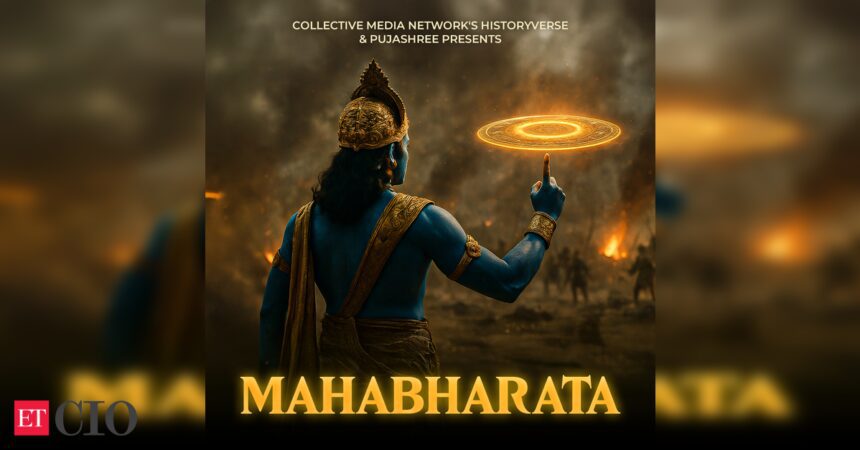

The battle of Kurukshetra transcends the traditional battlefield, finding new life at Galleri5, the cinematic lab and AI division of Collective Artist Network. Here, the process of filmmaking is reimagined through parameters such as camera angle, aperture, lighting, and motion. Instead of constructing kingdoms, they are assembled; rather than casting characters, they are generated. At the intersection of a director’s vision and a machine’s interpretation, an epic narrative materializes.
Rahul Regulapati, CEO of Galleri5 and partner at Collective Artists Network, articulates this transformation with a blend of technical precision and creative ambition. Their rendition of the Mahabharat, produced for the OTT platform Jio Hotstar and TV channel Star Plus, serves as a pivotal example. Regulapati notes, “We’ve been able to make full-fledged AI shows that are on national television.” He adds that Mahabharat has garnered over 50 million viewers, a figure that typically attracts studios eager for large audiences.
However, it’s the unique methodology that distinguishes Galleri5’s approach. Regulapati critiques the traditional filmmaking model, noting its excessive costs, stating, “Content production is becoming highly non-scalable… there’s no movie that’s less than Rs 100 crores.” In contrast, Galleri5’s internal economics permit a 30-minute episode to be produced for between ₹15 lakh and ₹40 lakh and completed in a matter of days, as opposed to multiple weeks required by conventional means.
This focus on efficiency reveals the potential for creative liberty. “In an AI movie, you would have like 50 different sets… directors can tell stories that they could never have been told before,” Regulapati explains, envisioning a filmmaking process unconstrained by physical limitations.
The generative aspect of AI is often misconceived as the starting point for cinematic creation. Regulapati swiftly counters this notion: “An AI movie is not done by a prompt.” Instead, Galleri5 employs a digital backlot integrating over 100 AI models, mimicking traditional film processes. Directors engage in familiar practices—choosing lenses, framing shots, and adjusting lighting—while the system translates these directives into what Regulapati describes as an “agentic pipeline.” This pipeline selects models and modifies prompts, generating, evaluating, and refining outputs.
In essence, this approach introduces an AI cinematographer, a synthetic counterpart to the traditional eye of a film. While the technology allows for unprecedented flexibility in production, challenges remain. Regulapati acknowledges that, “Expressions, emotions, dialogs… there are constraints.” To address this, actors don motion-capture suits, enabling their performances to be mapped onto 3D characters as data, effectively becoming the prompt for AI models.
What results is a sophisticated illusion where human performance is translated into code and then visualized on screen. Directors can monitor, make adjustments, and even reshoot sequences within hours. “The director feels in control of AI… he’s able to control the motion, he’s able to control the emotion, the performance,” Regulapati states, marking this as a significant departure within the medium.
Underpinning this technological innovation is vital infrastructure. Galleri5 relies on high-performance GPUs, including NVIDIA H100s, via a partnership with Microsoft Azure. The integration and fine-tuning of models are facilitated through numerous collaborations, and while progress is evident, challenges persist, such as technology capping at 1080p and models sometimes struggling with nuanced details.
Regulapati emphasizes an essential change in talent requirements, indicating that creators now need both traditional animation skills and robust engineering backgrounds. “People who have done traditional animation… but also have a very strong engineering background,” he notes, indicate that a new kind of creator is necessary for this evolving studio model.
Galleri5 is committed to being a tool provider for creators, rather than attempting to replace them. Regulapati states, “It’s not about a bunch of engineers… building the platform. We learn from how traditional filmmaking is working, and then try to use that inside an AI workflow.” This philosophy can be seen as an evolution that some may view as disruptive, as the capacity to produce large-scale productions rapidly changes the landscape of filmmaking.
As Regulapati asserts, “If we are able to crack this model… we’re going to disrupt the entertainment space.” While the role of storyteller remains vital, the integration of machines into the narrative process is becoming increasingly significant.