Ram Sahodev Gorai quietly walks at the protest site as his frail hands drag a thick stick for balance. It is another day of protest for the man in his late 80s.
At an age when Gorai is expected to retire and live a life of solace, he is instead forced to sit out and protest. Gorai, along with thousands of families, is protesting against a proposed floating solar power project on the Panchet Dam.
Panchet Dam is built across the Damodar River at Panchet, on the border of Jharkhand and West Bengal, near Dhanbad.
Historically known for its devastating floods, the Damodar River earned the nickname “Sorrow of Bengal.” In 1948, to control floods, generate electricity, and support irrigation, the Damodar Valley Corporation (DVC) was established, inspired by the Tennessee Valley Authority (TVA) model in the USA.
With tears in his eyes and a voice barely audible due to old age, Gorai tries to explain to Maktoob how he was abandoned by the authorities after his house and village were submerged during a devastating flood, leaving him and thousands of families homeless and landless.
The acquisition of land for the Panchet Dam began in 1952. In 1959, the Panchet Dam was inaugurated.

Mukhtar Ansari, a member of one of the families displaced by the dam, explains Gorai’s situation, saying that when the dam was completed, the flow of water suddenly increased and spread across the reservoir, drowning many villages.
“The villages that drowned, the families who lived there are still displaced. People are living in this situation even now. People lived in tents; some people drowned at that time. Many were rescued,” he said.
Gorai and his family lost everything in that devastation.
Sandhya Gorai, daughter of Ram Gorai, said her father also worked under the DVC, which had promised jobs to people displaced due to the dam’s construction. That promise, she said, largely remained unfulfilled, with only about one percent of the displaced receiving jobs.
“My father witnessed the construction of the Panchet Dam. At the time, we had no choice,” said Sandhya, an anganwadi worker, who could not control her anger towards the DVC.
Gorai’s wife, Patu Gorai, speaks in anguish, her pain clearly audible in her voice. Working as a domestic help in nearby houses, she told Maktoob how the family now lives in an old, abandoned DVC quarter. “They took everything from us and left us with nothing. I curse them for what they did to us. At this age, we are struggling to survive,” she said.

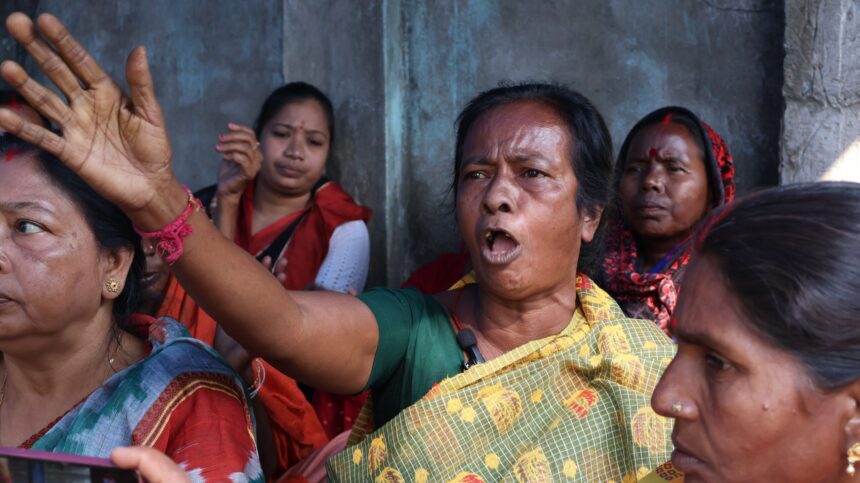
The family has two demands: compensation through land for what was lost, and an immediate halt to the solar project. “They have become millionaires on our land but have left us to beg. This is our land, and it is calling us back. That is why we are protesting,” Sandhya added.
Fight for land and compensation
For the construction of the dam, 30 to 35 acres of land were acquired, Ansari explained. Thousands of families were displaced in the process. They were promised adequate compensation and employment. However, protesters claim that for decades they have struggled to receive either.
DVC was established to protect West Bengal from floods. After the devastating floods of 1943, a committee was formed and a survey conducted to determine how floods could be controlled.
It was decided that eight dams would be constructed to regulate water flow. Initially, four dams were planned, and so far only those four have been built; the remaining dams are yet to be constructed.
Panchet Dam is the last of the four major dams built under the DVC project, the others being Tilaiya, Konar, and Maithon.
“About 10,000 families were affected due to land acquisition. Many people have still not been compensated, nor were they given jobs. This protest has been going on since 1968,” Ansari said.
While the majority of the affected are from fishing communities, others survive on daily wage labour, and many have been forced to migrate for work. Earlier, residents told Maktoob, people depended on farming.

The proposed solar project has reignited the protests, particularly among fishers who rely on the dam’s waters for their livelihoods. They allege that nearly 1,500 families would lose not only their livelihoods but also their primary source of affordable nutrition, solely due to the first phase of the project.
The protest is being led by various tribal organisations, including Bharat Jakat Majhi Pargana Mahal, the Damodar Valley Bastuhara Sangram Samiti (committee for the struggle of the displaced), the Bastuhara Matsyajibi Sangram Samiti (committee for the struggle of displaced fishers), and the Jami Raksha Committee (land protection committee).
In 1974, a large, organised movement emerged, led by displaced villagers, local leaders, and social activists.
The movement united people across caste, tribal, and village lines. Due to mounting pressure, DVC constituted an official panel in 1977 to identify “genuine displaced persons” and review compensation and rehabilitation claims. However, Ansari described the committee as a sham, stating that only 102 people were officially recognised, despite thousands of families being displaced and entire villages being excluded.
In 2009, marking the 50th anniversary of the Panchet Dam’s commissioning, residents of villages adjacent to the dam in Purulia district began demonstrations demanding “adequate compensation.” They alleged that compensation was meagre compared to their losses, many affected persons were excluded, and several promises remained unfulfilled.
Since then, villagers have continued protesting and raising these issues.
Ansari, one of the leading figures in the protests, said his own family was displaced during the dam’s construction and now lives on entirely different land. He added that several other issues have arisen due to the dam and the newly proposed project.

Fight for status and land
“Many tribal villages lost their land because their villages were submerged. Moreover, to prove that these people belong to Scheduled Tribes, families do not have proper documentation because everything was washed away,” Ansari said.
In a corner, Avinash Tudu listens silently to the speakers. Belonging to a tribal community, Tudu’s struggle is not only to protect his identity but also to reclaim his land. Living far away from his ancestral land, he travelled a long distance to attend the protest.
Tudu’s village was flooded after the dam was constructed, when water suddenly filled the reservoir and overflowed into adjoining villages. At that time, people were focused on saving their lives; documents were the last concern. “The documents were naturally destroyed. People decided to stay where they were and set up tents,” he said.
Tudu explained that the land they currently occupy belongs to someone else and that they were merely allowed to stay. It is still not their land.
A young man in his early 20s, Tudu said he grew up hearing the gruesome history of his community, which led him to join protests against the dam and the proposed projects.
As people struggle for land, their problems are compounded by issues related to Scheduled Tribe (ST) status. “They ask us for papers that drowned along with our village. Where are we supposed to get those papers from?” he asked.
This has led to further difficulties, with landowners now pushing families to vacate. “He is either asking us to pay for the land or leave. How are we supposed to pay such a huge amount?” Tudu asked.

People are being asked to pay up to ₹2 lakh for land, depending on the area used. “This government has also done nothing for us,” Tudu added.
Ansari said that with the Special Intensive Revision (SIR) process underway, people like Tudu may be removed from voter lists because their ancestors lost documents during floods.
“Despite years of protest, we have received no justice,” he said.
Another protester said the government has not communicated any proper rehabilitation plan, increasing anxiety among residents. There were also rumours of relocation to Hazaribagh, which villagers have outright rejected.
“Thousands of fishermen will be affected. Either provide them jobs or do not touch their livelihoods. People who are self-employed through such work are having their livelihoods snatched away,” Ansari said.
The new project
In its 2022–23 annual report, the Damodar Valley Corporation stated that it had received approval from the Union Ministry of New and Renewable Energy to establish floating solar parks with a capacity of 989 MW at its dam reservoirs under the Ultra Mega Renewable Energy Power Parks Scheme.
Subsequently, a joint venture company named Green Valley Renewable Energy Limited was formed, with 49 percent equity held by DVC and 51 percent by National Thermal Power Corporation Renewable Energy Ltd, a public sector undertaking.
According to DVC’s 2023–24 annual report, Green Valley Renewable Energy Limited is implementing two solar PV parks with a cumulative capacity of 755 MW in and around the Tilaiya and Panchet dam reservoirs under the Ultra Mega Renewable Energy Power Parks scheme. Of this 755 MW, contracts for 310 MW under Phase I have already been awarded.
These include awarding contracts to M/s Sterling & Wilson for a 155 MW floating solar photovoltaic project at Tilaiya, M/s L&T for a 75 MW floating solar PV project at Panchet, and M/s NGSL for an additional 80 MW at Panchet, comprising 30 MW of floating solar PV and 50 MW of ground-mounted projects.
Tenders for another 455 MW under Phase II, including projects at Tilaiya and Panchet, will be floated later. “These projects will not only contribute to our growing renewable energy portfolio but also enhance our efforts to reduce our carbon footprint,” the DVC annual report stated.

According to the government, a 100 MW floating solar park commissioned in Telangana in 2022 spans over 500 acres of reservoir water, while a 278 MW floating solar plant in Madhya Pradesh covers over 800 acres.
DVC plans to install 755 MW of capacity across Tilaiya and Panchet. Some protesters estimate, based on interactions with DVC officials, that 375 MW is planned for Panchet alone. Fishers living around the Panchet Dam fear losing access to approximately 1,500 acres of water.
“We will continue protesting because there is no other option. No minister is supporting us. We are completely alone, but that will not stop us,” Sandhya Gorai said.
A letter was sent to the Jharkhand Chief Minister’s office last month, once again highlighting the people’s situation. However, no response has been received.
Meanwhile, materials for the solar project have already begun arriving, with Maktoob witnessing massive solar panels stored just a few metres away from the protest site.
The post ‘My land is calling me’: Displaced villagers protest against proposed solar plant on Damodar River appeared first on Maktoob media.