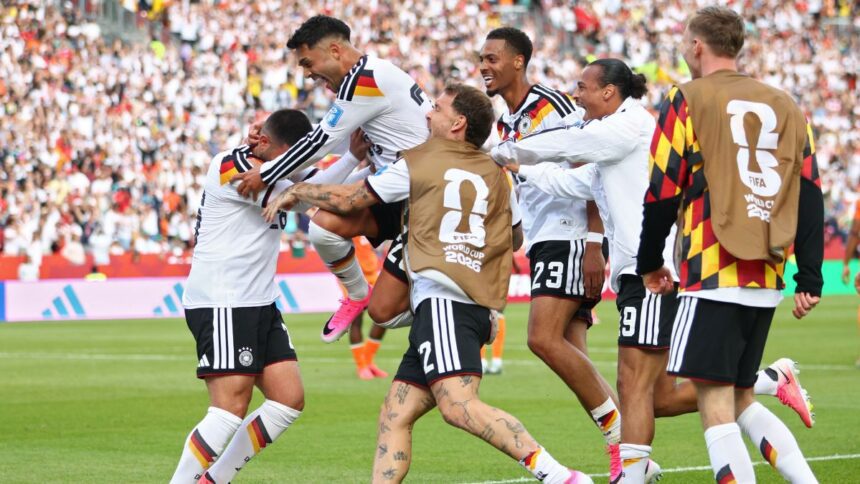

In a thrilling encounter at the FIFA World Cup 2026, Germany clinched a dramatic victory over Ivory Coast, thanks to Deniz Undav’s late heroics. The Stuttgart forward scored both the equalizer and the winner in stoppage time, showcasing his growing influence in the team and altering the dynamics of the match.
Germany’s Struggles and Comeback
Initially, Germany faced significant challenges against Ivory Coast’s well-drilled defense. While they had previously dominated their opening match against Curacao, this time, they struggled to find their rhythm. Ivory Coast’s aggressive pressing and strategic use of wide players put Germany on the back foot. The African side capitalized on this early, with Franck Kessie scoring the opening goal, leaving Germany needing to respond swiftly.
Despite controlling possession, Germany’s lack of clinical finishing and the compactness of Ivory Coast’s defense meant that their attempts at goal were often thwarted. Coach Julian Nagelsmann made crucial tactical adjustments by introducing substitutes Deniz Undav and Nadiem Amiri in the second half, which transformed Germany’s attacking dynamics. Amiri’s direct passing and Undav’s sharp movement created more opportunities in the final third.
Undav’s Match-Winning Performance
Deniz Undav emerged as the standout player for Germany, scoring both goals that turned the tide in their favor. His first goal was a result of timely positioning and quick reactions inside the box, capitalizing on Germany’s improved width and ball movement. This shift in strategy highlighted Undav’s potential as a critical component in Nagelsmann’s plans moving forward.
With the game hanging in the balance during stoppage time, Undav timed his run perfectly, receiving a pass that allowed him to slot home the winner. His performance not only secured the much-needed points for Germany but also showcased the depth of talent available to the national team, emphasizing the importance of utilizing substitutes effectively in high-pressure situations.
Implications for Future Matches
This match served as a crucial reminder of the importance of depth within a squad, particularly in a tournament format like the World Cup. As teams prepare for knockout stages, those with the ability to make impactful substitutions will have an edge. For fans in India, this highlights the potential of emerging players like Undav to become pivotal in their national teams, akin to the way younger talents are breaking into the Indian football scene.
Moreover, this game also reflects how teams are continuously evolving tactics to counter various styles of play, a lesson that Indian coaches and players can learn from as they push for improvement in the domestic league and international competitions.
What This Means
Germany’s victory against Ivory Coast has significant implications not just for the teams involved, but for fans and analysts globally, including in India. It underscores the unpredictability of knockout football, where tactical shifts and the performance of substitutes can become the game-changer. For Indian football, observing such high-stakes matches provides insights into strategic planning and the importance of having a versatile squad capable of adapting under pressure. It also serves as motivation for young players in India aspiring to make a mark in international football.
Frequently Asked Questions
Who scored the winning goal for Germany against Ivory Coast?
Deniz Undav scored the decisive goal in the 94th minute, completing a brace for the match.
How did Ivory Coast perform against Germany?
Ivory Coast played a strong match, initially taking the lead through Franck Kessie and displaying solid defensive organization and effective counter-attacks.
Why did Germany struggle initially in the match?
Germany struggled due to Ivory Coast’s aggressive pressing, which disrupted their possession play and forced them to adapt significantly throughout the match.
What lessons can Indian football learn from this match?
The match emphasizes the importance of tactical flexibility, effective substitutions, and the role of emerging players, which Indian football can incorporate in their development programs.