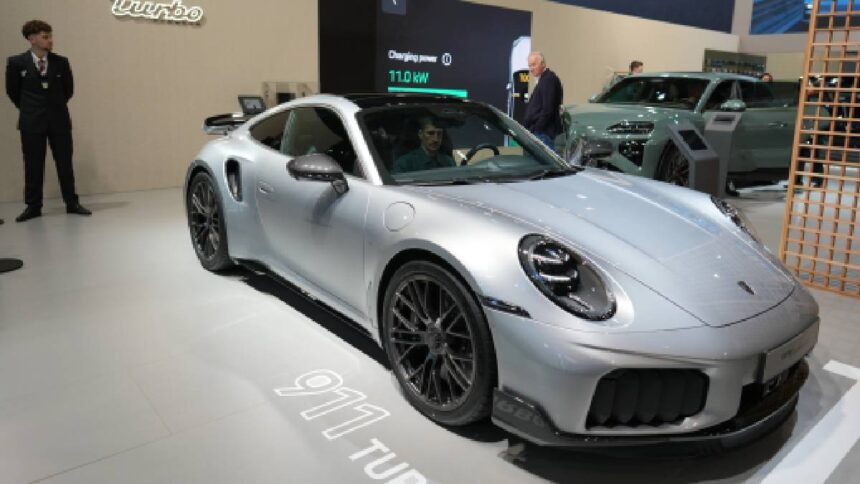
Premium luxury European car brands such as BMW, Mercedes-Benz, Lamborghini, Porsche, and Audi are expected to become more affordable in India once the bilateral free trade agreement (FTA) between India and the European Union comes into force, likely next year. According to an official, India will offer quota-based import duty concessions under the agreement.
Under the pact, the EU will phase out duties on Indian automobiles, while India will reduce import levies to 10 per cent for a specified number of vehicles.
Big relief for luxury brands like Lamborghini
Italian supercar maker Lamborghini, which sells vehicles in India starting at around Rs 3.8 crore and imports all its models, is expected to benefit significantly from the EU FTA.
India and the European Union announced the conclusion of negotiations for the free trade agreement on Tuesday. The agreement is expected to be signed later this year and could come into effect from early next year.
Trade talks resumed after a decade-long pause
European automakers and Indian consumers have been closely tracking the progress of the trade deal, negotiations for which began in 2007. Talks were paused in 2013 due to disagreements over duty concessions in the automobile sector, which was one of the most contentious issues.
As India’s automobile sector has strengthened, the country has become more open to offering duty concessions under FTAs. Similar quota-based concessions have already been extended to UK car manufacturers.
Quota-based duty concessions explained
According to a commerce ministry official, India and the EU have agreed on a quota-based duty concession model, as the EU had made aggressive demands in the automobile sector.
India continues to strongly protect its auto industry, which is a major employment generator and a key pillar of the government’s ‘Make in India’ initiative.
“The EU has one of the most advanced auto industries in the world, and their cars are among the best,” the official said, adding that the agreement balances sensitivities on both sides through a quota-based framework.
Cars below Rs 25 lakh protected
The official explained that India’s automobile market is largely dominated by cars priced between Rs 10 lakh and Rs 25 lakh, a segment in which EU manufacturers have limited interest.
As a result, cars likely to sell below Rs 25 lakh will not be exported to India by EU manufacturers. However, they may choose to manufacture such vehicles locally.
For India, vehicles priced below Rs 25 lakh represent the most important and fastest-growing segment, where domestic manufacturers are particularly strong.
Phased market access for premium cars
Vehicles priced above Rs 25 lakh — including petrol, diesel, and hybrid models — form a smaller but high-interest market in India. EU manufacturers are strong players in this segment.
India has granted quota-based market access for these vehicles, with the quota increasing gradually in phases. Duty concessions will apply only to a specified number of imported vehicles.
Currently, India’s import duty on automobiles ranges from 66 per cent to 125 per cent.
Push for local manufacturing in India
India will not offer any duty reduction beyond the agreed quota, encouraging EU manufacturers to explore local production opportunities.
“The idea is that beyond the quota, if the market grows, companies should manufacture in India,” the official said, noting that this approach would benefit both economies through shared value addition and supply chains.
The quota-based system is also expected to help create jobs in both India and the EU, while bringing advanced manufacturing technologies to India over the medium and long term.
Reciprocal market access for Indian automakers
For every car quota India grants to the EU, it will receive 2.5 times the quota access in the EU market. For example, if India allows 1 lakh cars, it will get access for 2.5 lakh cars in Europe.
While the EU market is nearly twice the size of India’s, Indian vehicles will receive complete duty-free access, whereas the EU will get phased, quota-based duty reductions over five years.
Price threshold and cost breakdown
The effective threshold under the agreement is 15,000 euros (approximately Rs 15 lakh). A car priced at this level will arrive at Indian ports under the FTA, after which duties, taxes, registration, and other costs can add Rs 10–12 lakh or more, depending on GST, insurance, freight, and logistics.
Electric vehicle duty cuts to start later
For electric vehicles (EVs), India’s quota-based duty concessions will begin from the fifth year of the agreement, as the domestic EV market and production are still growing.
Duty reductions for EVs will vary by segment, starting at 30–35 per cent in the first year and gradually decreasing over time.
Currently, imported passenger vehicles priced below USD 40,000 attract a basic customs duty of 70 per cent, while those priced above USD 40,000 face an effective duty of 110 per cent.
Government support for domestic auto industry
The government has introduced multiple measures to strengthen the domestic automobile industry. The Automotive Mission Plan 2047 (AMP 2047) is an industry-led initiative supported by the government to make India’s auto sector globally competitive.