
The recent assembly elections in West Bengal garnered significant attention in Bangladesh, particularly highlighting the Bharatiya Janata Party’s (BJP) historic victory, which marks the party’s first time in power in this strategically crucial eastern border state. This victory represents a shift in the political landscape of Kolkata, aligning it ideologically with the central government in New Delhi for the first time since Narendra Modi took office in 2014.
This electoral success comes as Bangladesh also undergoes a leadership transition; Tarique Rahman of the Bangladesh Nationalist Party (BNP) assumed the position of Prime Minister following general elections held 18 months after widespread public protests led to the end of Sheikh Hasina’s 15-year rule under the Awami League. The political climate between New Delhi and Dhaka had deteriorated markedly during the caretaker administration of Muhammad Yunus, which followed Hasina’s tenure.
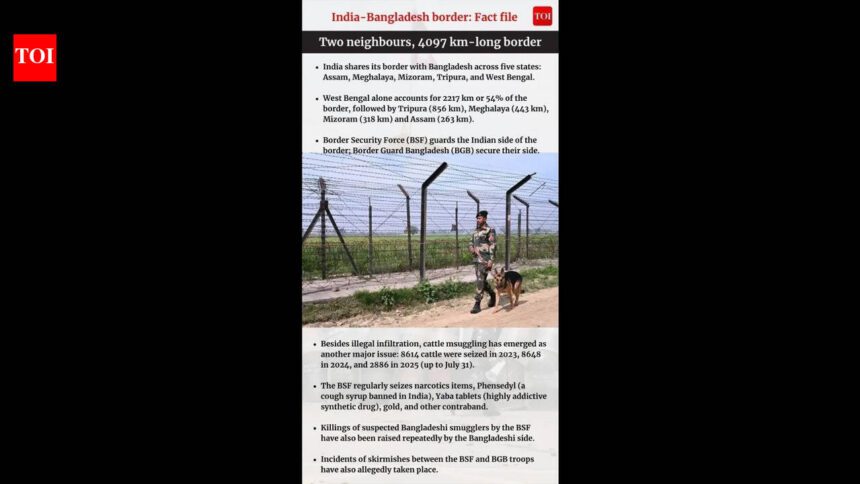
The BJP now governs three of the five states that share borders with Bangladesh, with Meghalaya under the administration of an ally, the National People’s Party. West Bengal’s 2,217-kilometer border constitutes nearly 54% of the total 4,096-kilometer checkpoint between the two nations, making the state especially vulnerable to illegal immigration. The BJP previously accused the outgoing Trinamool Congress (TMC) government, led by Mamata Banerjee, of harboring Bangladeshi “infiltrators” as a means to secure electoral support, and of hindering the Border Security Force (BSF) from acquiring necessary land for border fencing.
In response to this, the new administration’s first acts included transferring land to the Union home ministry for border fencing, which is expected to be completed in six weeks. This decision evoked a prompt response from Dhaka, with Humayun Kabir, foreign affairs advisor to Prime Minister Rahman, asserting that Bangladesh “isn’t afraid of barbed wire.”
As of August 2025, around 1,648 kilometers (74%) of the West Bengal-Bangladesh border had been fenced. Of the 569 kilometers remaining, 456 kilometers were deemed feasible for fencing while 113 kilometers were classified as nonfeasible. The acquisition of land for the feasible stretch faced delays attributed to the TMC’s administration.
There is speculation that West Bengal could adopt an “Assam model” in managing illegal immigration, similar to what has been implemented by Assam’s Chief Minister Himanta Biswa Sarma. Following his swearing-in, Sarma shared a photo with Suvendu Adhikari, West Bengal’s new chief minister, with a caption interpreted as referring to alleged illegal immigrants. Sarma’s government has established a “pushback” policy to return suspected illegal immigrants to Bangladesh, which drew diplomatic protests from Dhaka.
On a more conciliatory note, there are expectations surrounding the long-anticipated Teesta river water-sharing agreement. Previous attempts to finalize this treaty stalled during Banerjee’s administration, which opposed sharing the river’s waters. The BNP has characterized Banerjee as an “impediment” to this agreement, expressing hope that the new BJP government would facilitate progress.
The BJP’s victory coincided with the appointment of Dinesh Trivedi as India’s next high commissioner to Bangladesh, a political figure rather than a career diplomat, indicating New Delhi’s strategy to enhance its relations with Dhaka through political engagement. Various Indian officials have shown support for Rahman’s administration, further solidifying this diplomatic outreach.
The BJP’s “double-engine” model is now active in West Bengal, promoting closer coordination between the state and central authorities, particularly concerning Bangladesh. However, while the BJP has emphasized border security and managing illegal immigration as key electoral themes, balancing these issues without exacerbating tensions with Bangladesh—particularly as both nations aim to rebuild trust—will be crucial for the new administration. The electoral victory marks a pivotal moment, but the future actions of the Adhikari government will be key in determining the trajectory of the relationship between West Bengal and Bangladesh.