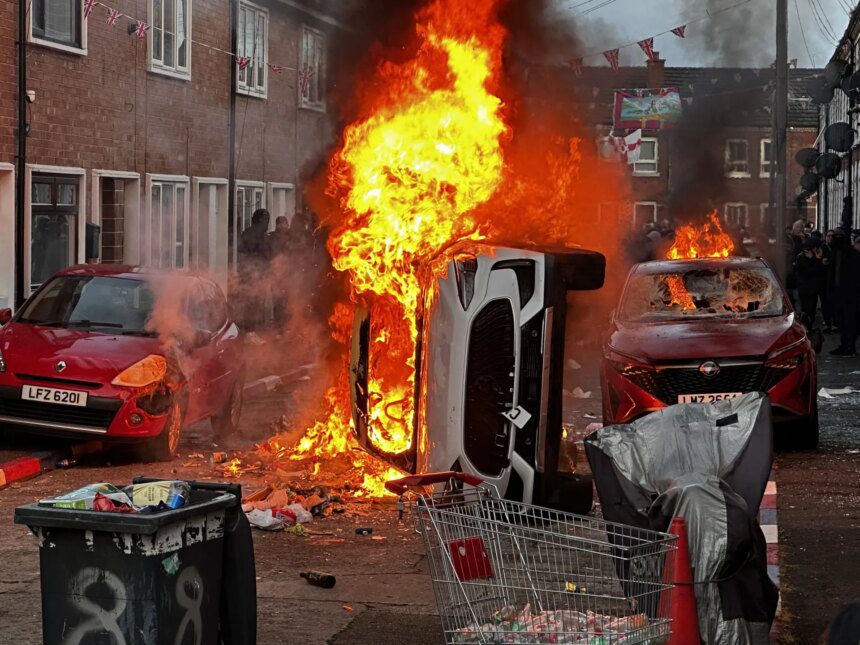

Protests turned violent in Belfast, Northern Ireland, as anti-immigration sentiments flared following a graphic knife attack that has raised tensions across the region. Demonstrators clashed with law enforcement, torched vehicles, and set buildings ablaze in response to fears surrounding immigration policies and public safety.
Increased Violence and Public Outcry
On Tuesday evening, hundreds of masked protesters took to the streets of Belfast, igniting a bus and several cars while a building near the city center was engulfed in flames. Residents had to evacuate as police deployed helicopters to monitor the unfolding chaos. This unrest follows a particularly disturbing knife attack that occurred late Monday night in north Belfast, which was caught on video and shared broadly on social media. British Prime Minister Keir Starmer described the attack as “sickening,” reflecting widespread outrage over violent incidents attributed to rising tensions regarding immigration.
The Role of Immigration in Current Political Climate
The unrest highlights ongoing frustrations surrounding the UK’s immigration policies, particularly concerning asylum seekers. Populist parties have gained traction by asserting that ineffective immigration laws have allowed dangerous individuals into the UK. This anger was palpable during earlier anti-immigration riots in Northern Ireland, significantly following an alleged sexual assault tied to immigration issues. As tensions escalate in recent months, fueled by incidents like the murder of a student who was wrongfully accused of instigating a racist attack, the dialogue surrounding immigration becomes more charged and complex.
Political Leadership’s Response
Northern Ireland’s political leaders, along with the region’s chief constable, have appealed to the public to refrain from inciting hate and fear. They have urged citizens to consider the broader implications of targeting specific communities based on isolated incidents. The ongoing violence and unrest raise questions about the stability of bipartisan relations in Northern Ireland, a region still recovering from its fraught history marked by divisions along political and sectarian lines.
What This Means
For Indian readers, this situation is a stark reminder of how immigration can evoke intense public sentiment, mirroring debates that occur in many countries, including India. The rise of populist movements, fueled by anti-immigrant narratives, hasn’t been exclusive to the UK; India, too, witnesses discussions around migration that often become politically charged. Moreover, such events highlight the critical need for inclusive policies and community-based interventions to mitigate fears and foster dialogue rather than division, serving as a lesson for governance in culturally diverse societies.
Frequently Asked Questions
What sparked the protests in Belfast?
The protests were ignited by a graphic knife attack in north Belfast that was widely circulated on social media. This incident heightened already existing anti-immigration sentiments.
How did the authorities respond to the violence?
Police deployed helicopters to monitor the situation and took measures to contain the protests as buildings and vehicles were set ablaze by demonstrators.
What are the main concerns regarding immigration in the UK?
Concerns primarily revolve around the effectiveness of asylum policies and public safety, especially in the wake of violent incidents tied to immigrant identities.
What have political leaders in Northern Ireland said about the protests?
Northern Ireland’s political leaders have urged for calm and called on the public to avoid inciting hate and targeting specific communities based on these incidents.