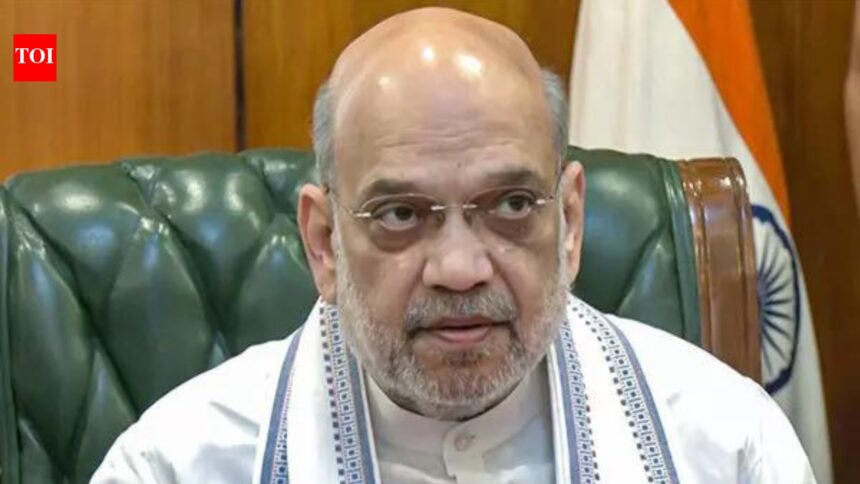

NEW DELHI: Home Minister Amit Shah has advocated for a strict zero-tolerance policy toward unauthorized encroachments within 0-15 kilometers of the international border. During a meeting in Bhuj on Friday aimed at reviewing the security of Gujarat’s land and coastal borders, he instructed local administrations and police in border districts to dismantle such encroachments and maintain vigilance against radicalization in these areas.
Shah emphasized the need for collaboration among all levels of local administration, from police staff to patwaris, to expedite the deportation of settled illegal infiltrators. He urged local authorities to develop standard operating procedures (SOPs) tailored to address the unique challenges faced by each border district, while also identifying existing infiltrators and monitoring threats posed by drones and narcotics trafficking.
The meeting was attended by Gujarat’s Chief Minister, Deputy Chief Minister, Chief Secretary, and Director General of Police (DGP), along with district magistrates and superintendents of police from Kutch, Vav-Tharad, and Patan. The discussions focused on addressing challenges and emerging threats along the India-Pakistan border, highlighting the important role of state-level officials—particularly district magistrates and superintendents of police.
Reinforcing a nationwide agenda to combat illegal immigration and the demographic changes it may provoke in border regions, Shah directed district magistrates to closely monitor demographic shifts occurring within their jurisdictions.
Shah proposed the establishment of security coordination groups for each district, comprising officials from the Border Security Force (BSF), Coast Guard, Income Tax Department, and Enforcement Directorate, along with lead bank managers. He stated that district magistrates, superintendents of police, and inspector generals for border ranges would be accountable for enforcing income tax, anti-money laundering, and customs regulations.
The Home Minister stressed the importance of vigilance over hawala transactions and suspicious financial activities in border districts, instructing agencies focused on financial crimes to remain informed about border developments. He called for comprehensive survey campaigns by the Income Tax Department in collaboration with the Reserve Bank of India to address these issues.
Given Gujarat’s proximity to the international maritime boundary line, Shah highlighted the urgency of enhancing coastal security and ensuring effective coordination with the Indian Coast Guard. He directed that all government schemes, both central and state, must be fully implemented in border villages, akin to the ‘Vibrant Villages’ initiative.
Shah noted that border fencing, maritime security, and the state government’s political will have significantly improved Gujarat’s security environment, leading to a total halt in infiltration and smuggling. He also remarked on the positive trend of reverse migration from industrial growth in Gujarat’s border regions.