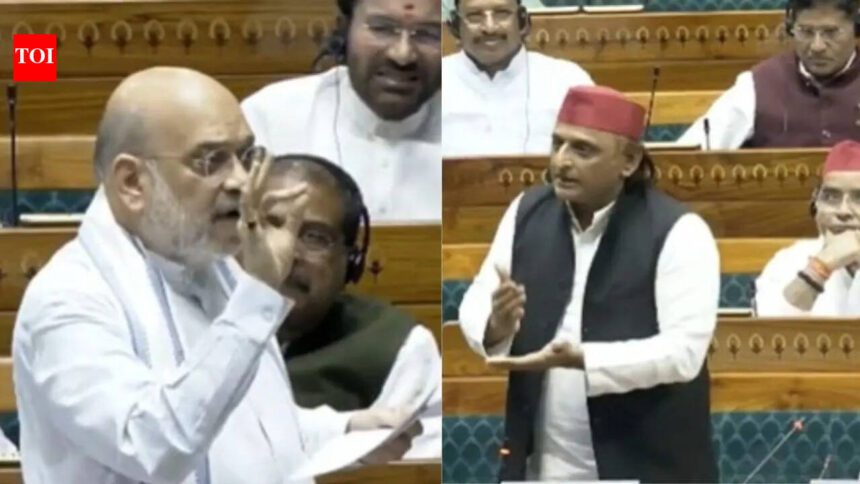

NEW DELHI: Union Home Minister Amit Shah on Friday proposed that the Lok Sabha proceedings be paused for an hour to allow him to introduce an official amendment advocating a 50% increase in the number of parliamentary seats per state following delimitation. “If the reason to oppose this bill is the demand for a 50% reservation, then halt the proceedings for an hour, and I will bring an official amendment to this bill. However, the opposition must first promise to pass the bill,” Shah stated.
He highlighted that the current parliamentary representation of Karnataka, Andhra Pradesh, Telangana, Tamil Nadu, and Kerala, which holds 129 out of 543 seats — approximately 23.76% — would increase to 195 seats, or roughly 23.87%, after the proposed 50% increase, resulting in a total of 816 seats.
In response, Samajwadi Party (SP) chief Akhilesh Yadav dismissed Shah’s proposal, reflecting skepticism regarding the ruling BJP’s track record since it came into power in 2014. “Based on nearly 11 years of experience, even if the BJP were to give a written assurance that they would appoint a woman prime minister, we still would not trust them,” Yadav asserted.
Opposition parties have labeled the proposal for delimitation as “dangerous,” raising concerns that incrementing the Lok Sabha’s strength from 543 to approximately 850 seats could diminish representation for southern, north-western, north-eastern, and smaller states. They contend that any new allocation of seats based on population growth would advantage more populous states while disadvantaging those that have managed to control population increase.
Furthermore, the opposition has connected the delimitation initiative to women’s reservation, urging the government to implement a 33% quota immediately based on the present strength of 543 seats, as outlined in Article 334A, passed in 2023. They argue that since the provision stipulates that the quota will be activated post-delimitation based on the 2027 Census, the government could expedite the process using updated census data ahead of the 2029 general elections. The reliance on the older 2011 Census for this process has also drawn criticism from opposition leaders.