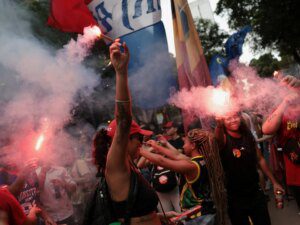
In a significant demonstration against Brazil’s political trajectory, thousands of people in Rio de Janeiro participated in a student-led protest against presidential candidate Flavio Bolsonaro. The rally, occurring shortly after Bolsonaro garnered the most votes in Brazil’s presidential election, reflects deep concerns about a potential shift towards the far right under his leadership.
Context of the Protests
The protests erupted following the first round of Brazil’s presidential elections, where Senator Flavio Bolsonaro, son of former President Jair Bolsonaro, received 47 percent of the vote. This puts him ahead of the incumbent left-wing President Luiz Inacio Lula da Silva, who secured 45 percent. Flavio Bolsonaro’s progress to the runoff, scheduled for October 25, has raised alarms among various social groups, particularly among those who have suffered under his father’s far-right governance.
During the rally, demonstrators carried signs with slogans like “Never again Bolsonaro” and “Get out Bolsonaro,” illustrating the public’s strong rejection of the political legacy associated with the Bolsonaro family. Protester Alice Carneiro expressed her fears regarding potential backlash against marginalized communities, specifically mentioning concerns for her transgender wife under a far-right administration.
Legacy of the Bolsonaro Administration
Jair Bolsonaro’s presidency from 2019 to 2023 was fraught with controversy, characterized by a series of aggressive far-right policies. Notably, he openly supported Brazil’s past military dictatorship, which was known for its brutal suppression of dissent, including the disappearances and killings of many activists. His presidency also sparked widespread criticism for undermining democracy through unfounded claims regarding the electoral process.
Currently, Jair Bolsonaro faces a 27-year prison sentence after being found guilty of plotting to overturn the results of the 2022 elections. This backdrop is crucial in understanding the apprehensions surrounding his son’s candidacy, especially with simultaneous unrest from Bolsonaro’s supporters, who once stormed government buildings, indicating a possible inclination towards violence in a transition of power.
Rise of the Far Right in Brazil
The political landscape in Brazil is increasingly polarized, with fears that it mirrors similar trends seen in other countries in Latin America, where leftist governments have frequently faced strong opposition from far-right factions. Critics emphasize that Flavio Bolsonaro’s rise could further embolden extremist views and policies, suppressing democratic ideals that many Brazilians hold dear.
Protester Emmanuel Araujo articulated a sentiment shared by many: “Lula might not be my preferred candidate, but amid this barbarism, we have to choose between someone we can keep criticising and someone who might take away our right to speak.” This perspective exemplifies the urgency felt by younger generations, who worry about their civil liberties in the face of possible authoritarian regimes.
What This Means
For readers in India, the evolving political scene in Brazil serves as a reminder of the fragility of democracy worldwide. As societies grapple with authoritarian tendencies, it highlights the importance of civic engagement and activism. India’s own political landscape, with its dynamic confrontations between various ideologies, mirrors some of these challenges. Understanding Brazil’s situation may inspire similar movements among Indian youth who are concerned about their democratic rights and societal values. Furthermore, the tensions emerging in Brazil might catalyze discussions on governance and civil rights in India.
Frequently Asked Questions
What is the historical context of Jair Bolsonaro’s presidency?
Jair Bolsonaro served as president from 2019 to 2023, during which he endorsed Brazil’s military dictatorship and faced multiple controversies regarding his far-right policies and handling of various social issues.
What concerns do Brazilians have regarding Flavio Bolsonaro’s candidacy?
Brazilians are worried that Flavio Bolsonaro’s election could signify a continuation of authoritarian practices, further marginalization of vulnerable communities, and a deviation from democratic norms.
When is the runoff election set to take place?
The runoff election between Flavio Bolsonaro and Luiz Inacio Lula da Silva is set for October 25, following the first round results that did not yield a clear majority for either candidate.
How do these events relate to political dynamics in India?
Similar to Brazil, India faces its own challenges concerning democratic values and political polarization, making the developments in Brazil relevant for understanding global trends in governance and civil rights.