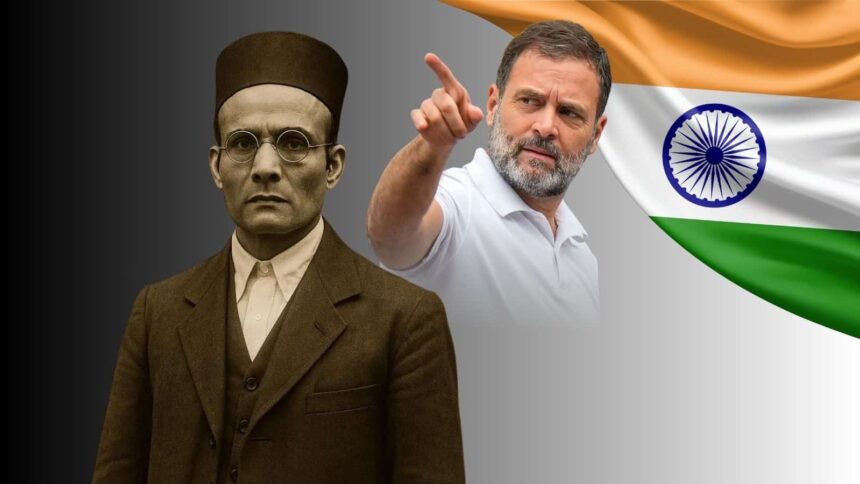

Disputed Claims Surround V D Savarkar’s Legacy
Satyaki Savarkar, the grandnephew of the controversial Hindutva ideologue V D Savarkar, recently testified in court defending his ancestor’s legacy amidst ongoing debates about his views on Muslims. This legal battle, ignited by Congress leader Rahul Gandhi’s statements in London, highlights the complexities surrounding historical narratives and their implications for contemporary politics in India.
Context of the Defamation Case
The defamation case against Rahul Gandhi claims that his statements portrayed V D Savarkar as an “extreme hater of Muslims,” undermining his reputation. During the cross-examination, Satyaki Savarkar argued that Gandhi misrepresented his grandfather’s views, emphasizing that Savarkar’s writings advocated for the progress of Muslims rather than hatred. This assertion is significant in the context of ongoing political discourse, where historical figures are often invoked to consolidate modern-day ideologies.
Advocate Milind Pawar questioned Satyaki about specific quotes from Gandhi’s allegations, which included an assertion that Savarkar wrote about assaulting a Muslim youth. Satyaki retorted that such phrasing unjustly characterized his grandfather as a “mob lyncher” and failed to represent Savarkar’s broader messages about communal harmony and empowerment.
The Role of Historical Narratives in Political Discourse
The courtroom proceedings reflect a larger battle over historical interpretation in India. The BJP and its affiliates have often leveraged Savarkar’s legacy as a symbol of Hindu nationalism, while opponents argue that the same legacy promotes divisiveness. Satyaki’s defense aims to reposition Savarkar as a more nuanced figure who is mischaracterized by political opponents seeking to undermine the BJP’s ideological foundation.
Notably, Satyaki’s statements coincide with incidents of social and economic marginalization faced by Indian Muslims, who often voice concerns over being portrayed as the ‘other’ in a political landscape increasingly dominated by Hindutva rhetoric. The framing of Savarkar’s ideologies within such contexts enables a broader understanding of community dynamics and minority experiences in India.
The Legal and Social Implications
This defamation case not only raises questions about personal reputations but also touches on the societal implications of historical discourse. As public figures reinterpret past legacies, it’s crucial to examine how these narratives affect minority communities. The rising polarization can lead to economic boycotts and increased social exclusion for Indian Muslims, particularly when historical figures are utilized to galvanize support for contentious policies or ideologies.
Satyaki’s grandfather, Gopal Godse, had previously acknowledged the affiliation of his brother, Nathuram Godse, with the RSS, which complicates the narrative surrounding Savarkar’s legacy. This familial connection draws attention to the difficulties of disassociating historical figures from the ideologies attributed to them, encouraging a questioning of how histories are shared and who benefits from these retellings.
Why It Matters
The implications of this case extend beyond the political arena, inviting scrutiny into the narratives that shape society’s understanding of communal relations in India. As public figures like Rahul Gandhi evoke historical claims, they inadvertently influence the perceptions of minority communities such as Muslims, who may feel increasingly marginalized. This discourse affects social cohesion, impacts policies, and can stir communal tensions that resonate throughout various layers of society. Analyzing these dynamics helps elucidate the ongoing struggle for representation and equity within a historically fragmented landscape.
Frequently Asked Questions
What was the main contention of Rahul Gandhi’s statements regarding V D Savarkar?
Rahul Gandhi alleged that Savarkar wrote about an incident where he and his friends assaulted a Muslim youth, suggesting that Savarkar harbored hatred towards Muslims.
How did Satyaki Savarkar respond to these allegations in court?
Satyaki Savarkar claimed that his grandfather never hated Muslims and emphasized that Savarkar’s writings supported their progress, asserting that Gandhi’s statements misrepresented this legacy.
What are the broader social implications of this legal case?
The case underscores ongoing communal tensions in India and highlights how historical narratives can influence the social and economic marginalization faced by Indian Muslims.
Why is V D Savarkar considered a controversial figure?
V D Savarkar is viewed as controversial due to his advocacy of Hindutva, which has been interpreted differently across political lines, leading to accusations of promoting divisive ideologies that marginalize non-Hindu communities.