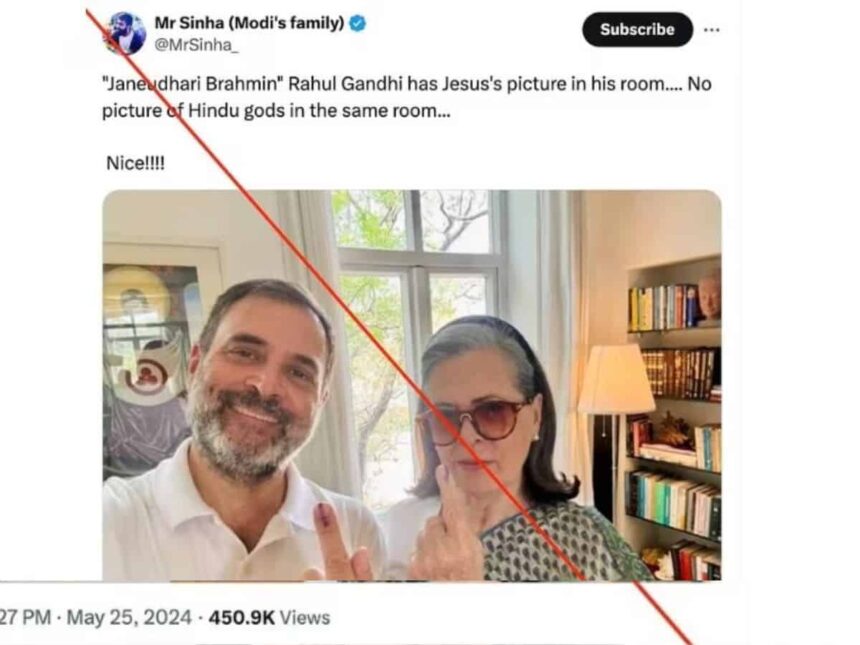

Selfie Controversy Sparks Misinformation
A recent selfie featuring Congress leader Rahul Gandhi and his mother, Sonia Gandhi, drew substantial attention after being posted on social media. Right-wing users misrepresented the image, falsely claiming that a painting of Jesus Christ hangs in the background, while overlooking the actual artwork’s true identity.
Unraveling the Misleading Claims
After casting their votes in the 2024 Lok Sabha elections, Rahul and Sonia Gandhi shared a selfie that quickly went viral online. Some users, particularly from right-wing circles, capitalized on the image to spread misinformation, alleging that it depicted Jesus Christ. They pointed to the artwork in the background and used this to criticize Gandhi for supposedly not showcasing Hindu deities in his home.
These claims drew attention from various fact-checkers who investigated the painting. It was revealed that the artwork is not related to Jesus Christ but is, in fact, “Madonna Oriflamma,” a painting by the Russian artist Nicholas Roerich, created in 1932. This particular piece symbolizes peace and is currently exhibited at the Nicholas Roerich Museum in New York City.
The Role of Misinformation in Political Discourse
This incident highlights the pervasive issue of misinformation in Indian political discourse. Social media platforms have become battlegrounds for various groups, each attempting to sway public perception for political gain. The nature of these claims—rooted in misrepresented images—serves to further polarize opinions, particularly in a politically charged environment like India’s.
Notably, a right-wing user, known for disseminating communal and misleading content, shared the selfie with a provocative comment about Gandhi being a ‘janeudhari brahmin’—a reference to a Hindu sect. This incitement only intensified the misinformation campaign, as multiple accounts began propagating the same narrative, underscoring how quickly falsehoods can circulate in today’s digital landscape.
Why This Matters
Understanding the implications of such misinformation is crucial for Indian readers. The spread of false claims not only affects individual reputations but also contributes to broader societal divisions. In a country diverse in beliefs, misrepresentations can fuel communal tensions and distract from substantive political discussions. Moreover, this incident exemplifies the power of social media in shaping narratives, making it imperative for voters to critically assess the information they consume.
Frequently Asked Questions
What is the artwork in the background of Rahul and Sonia Gandhi’s selfie?
The painting is titled “Madonna Oriflamma,” created by Russian artist Nicholas Roerich in 1932. It is known for its symbolism of peace and is part of the collection at the Nicholas Roerich Museum in New York.
What false claims were made regarding the selfie?
Right-wing users falsely claimed that the painting depicted Jesus Christ and criticized Rahul Gandhi for not having Hindu deities in his home, framing it as a contradiction to his identity as a ‘janeudhari brahmin.’
How do misinformation campaigns affect political discourse in India?
Misinformation campaigns amplify existing societal divisions and distract from important political issues. They can manipulate public perception and influence voter behavior in a highly polarized political environment.
What steps can be taken to combat misinformation on social media?
Developing media literacy among users, promoting fact-checking organizations, and encouraging responsible sharing of information are vital steps toward combating misinformation on platforms.