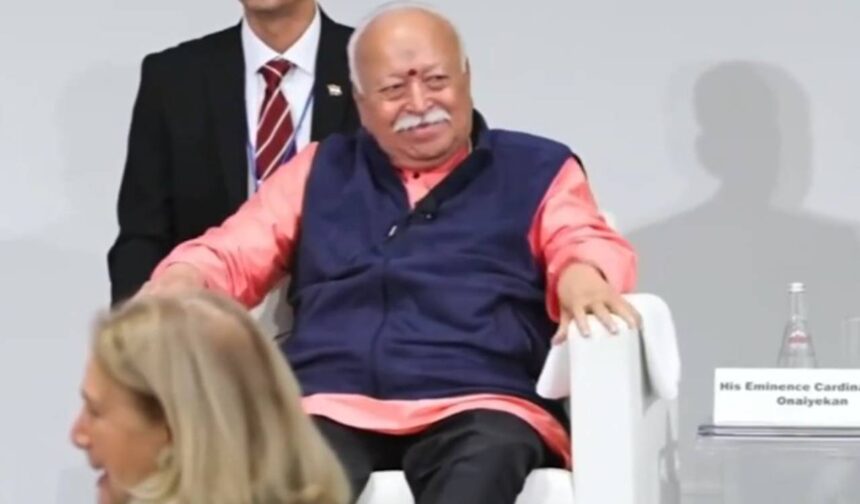

RSS chief Mohan Bhagwat recently stated at a conference in New York that any Hindu promoting exclusion of Muslims ceases to be a Hindu, emphasizing the need for religious tolerance and human dignity. However, this assertion surfaces amid ongoing concerns about discrimination and marginalization of Indian Muslims under the rule of the BJP and the RSS.
Context of Discrimination Against Indian Muslims
India has witnessed an increasing trend of social exclusion and discrimination against Muslims, particularly under the BJP government since it came to power in 2014. Reports of violence, harassment, and economic boycotts against Muslim communities have become more common, contributing to a climate of fear and marginalization. The rhetoric surrounding Hindutva ideology, which often elevates Hindu identity while sidelining minority communities, raises pressing concerns about social cohesion in the country.
Bhagwat’s statement, while promoting the idea of inclusivity, starkly contrasts with the lived experiences of many Muslims who face systemic bias. Activists argue that such rhetoric can often feel disingenuous when juxtaposed with actions perceived as discriminatory by the ruling party, which has been accused of fostering division for political gain.
Bhagwat’s Remarks on Hindutva and Humanity
During his address at the “One World, One Humanity” faith leaders’ conference, Bhagwat recalled a 2018 incident where Muslim attendees questioned the RSS’s stance on their place in India. He asserted that true Hindutva acknowledges the dignity of every human being, recognizing religious diversity. “If any Hindu thinks that there should be no Muslim in Bharat, he ceases to be a Hindu,” he stated. This perspective parallels his broader philosophy that all religions seek the same truth, which could promote a spirit of unity.
Despite his proclamations promoting coexistence, critics argue this message is undermined by societal realities where Muslims face discrimination ranging from social ostracism to economic boycotts. Many struggle to find work, secure housing, and access education, raising questions about whether the principles Bhagwat espouses are being genuinely propagated within the current socio-political framework.
The Role of Leadership in Promoting Social Harmony
Bhagwat emphasized the role of religious leaders in educating society about unity and coexistence. He acknowledged that deviations from these values are noticeable in contemporary India and suggested that religious leaders have a responsibility to reinforce this wisdom among their communities. He stated, “This has to be done from time to time by religious leaders,” underlining the necessity of ongoing dialogue about social harmony.
However, the constant burden placed on religious leaders to bridge divides raises significant challenges. The task is perceived as difficult given the existing socio-political circumstances, including rising intolerance and increasing instances of communal violence. There is a need for consistent efforts across all levels of society—not just among religious leaders—to foster an environment of acceptance and understanding, particularly towards marginalized communities like Muslims.
Why It Matters
The implications of Bhagwat’s statements extend beyond the immediate context of Hindu-Muslim relations. As India grapples with issues of social justice and inclusion, its response to minority rights will significantly influence its global image. Economically, the exclusion of marginalized groups can stymie progress and innovation by limiting participation in broader societal structures. Furthermore, a society rooted in tolerance and inclusivity may enhance domestic stability and international relations.
In the context of artificial intelligence and data privacy, a society that embraces diversity may advance more collaborative technological solutions, fostering a landscape that integrates various cultural perspectives rather than isolating them. As businesses and organizations engage in ethical practices, they must recognize the interconnected nature of social dynamics and their responsibilities toward marginalized populations.
Frequently Asked Questions
What is the RSS and its role in Indian society?
The Rashtriya Swayamsevak Sangh (RSS) is a volunteer-based cultural organization in India founded in 1925, primarily promoting Hindu cultural and national identity. It has become one of the largest social organizations in India, with a significant influence on the ruling BJP party.
What does Hindutva mean?
Hindutva is a term referring to Hindu nationalism, often emphasizing a cultural identity based on Hindu values. It seeks to define Indian culture in terms of Hindu traditions and ideals, sometimes marginalizing non-Hindu communities.
How does Bhagwat’s message intersect with current social issues?
While Bhagwat advocates for inclusive dialogue and coexistence, many argue that his sentiment contrast with lived realities of discrimination faced by Muslims in India, highlighting a disconnect between rhetoric and action within the current governmental framework.
Why are inter-religious dialogues important?
Inter-religious dialogues promote understanding, tolerance, and peaceful coexistence among different faiths. Such conversations are essential in multi-religious societies like India, particularly in addressing issues of discrimination and fostering social harmony.