A recent incident in Uttar Pradesh’s Sambhal district has reignited debates on communal tensions and the treatment of minorities in India. The demolition of the Mustafa Qadri mosque, marked by the discovery of controversial posters proclaiming “I Love Mohammad,” has sparked both local unrest and broader political ramifications, highlighting issues of discrimination and marginalization faced by the Muslim community.
Background of the Mosque Demolition
The Mustafa Qadri mosque, located in Kaserua village of the Nakhasa area, was demolished under claims that it was constructed on government-owned cemetery land. Local authorities executed this demolition following a court order, alleging encroachment on approximately 120 square meters of land designated as a graveyard in official records. The mosque committee was unable to present adequate documentation to prove ownership during legal proceedings.
Despite an appeal to the District Magistrate’s court, the mosque’s status remained unchanged, culminating in its demolition. The operation was met with a heavy police presence, and local Muslim worshippers were reportedly praying at the mosque just before it was razed, underscoring the communal tensions surrounding the event.
Police Investigation and Political Consequences
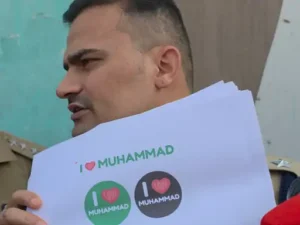
Following the mosque’s demolition, police discovered posters expressing love for the Prophet Muhammad along with a green flag inside the mosque, prompting an immediate investigation. Krishna Kumar Bishnoi, a police officer involved, stated, “We have taken the posters and flags into custody. It is being investigated who placed them there and for what purpose.” An FIR has since been filed against seven individuals linked to the mosque committee, introducing further complications in an already volatile situation.
Local MP Zia Ur Rehman Barq criticized the incident, expressing his support for the posters and challenging those responsible for the demolition, saying, “I will say ‘I Love Muhammad’. If you have courage, hang me.” His remarks highlight the political dimensions of the issue, as they reflect not only a defense of religious freedom but also a confrontation with prevailing political authorities.
The Broader Implications of Religious Marginalization
This incident is not isolated; it fits a troubling trend of anti-Muslim sentiment in India, particularly under the governance of the Bharatiya Janata Party (BJP) and affiliated groups. Reports have surfaced concerning discriminatory practices against Muslims across various sectors, including access to education, employment, and housing. In many cities, Muslims find themselves marginalized, with limited recourse to justice in land disputes and other communal matters.
The demolition of religious structures has become a focal point for broader communal conflicts, often overshadowing the fundamental rights of minority communities. As evidenced by the reaction of the local Muslim community to the mosque’s demolition, there is a palpable sense of injustice among those who feel that their religious practices and identities are under attack. The implications reach far beyond Sambhal, affecting the socio-political fabric of India, leading to further divisions within society.
Why It Matters
The recent incident surrounding the mosque in Sambhal is significant for understanding the socio-political landscape of India. It demonstrates how state actions can reinforce systemic discrimination and exclusion of minority communities, notably Muslims. The targeting of religious structures and the subsequent criminalization of cultural symbols not only challenge religious freedoms but also serve as a barometer for social cohesion in a diverse society. The patterns of marginalization revealed by incidents like this could have lasting effects on community relations and social justice, which are crucial for a stable, thriving democracy.
Frequently Asked Questions
What led to the demolition of the Mustafa Qadri mosque?
The mosque was demolished under the claim that it was constructed on government-owned land designated as a cemetery, following a court order and allegations of encroachment.
What did the police find inside the mosque after its demolition?
Police discovered posters reading “I Love Mohammad” and a green flag inside the mosque, which prompted an investigation into who placed them there.
What political reactions have emerged in response to the incident?
Local MP Zia Ur Rehman Barq criticized both the demolition and the controversy over the posters, asserting his support for the message and challenging the authorities involved.
How does this case reflect broader issues affecting Indian Muslims?
The incident exemplifies ongoing discrimination and marginalization faced by Muslims in India, as state actions against religious sites often correlate with systemic biases in various aspects of life, including land disputes and access to justice.