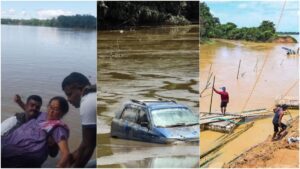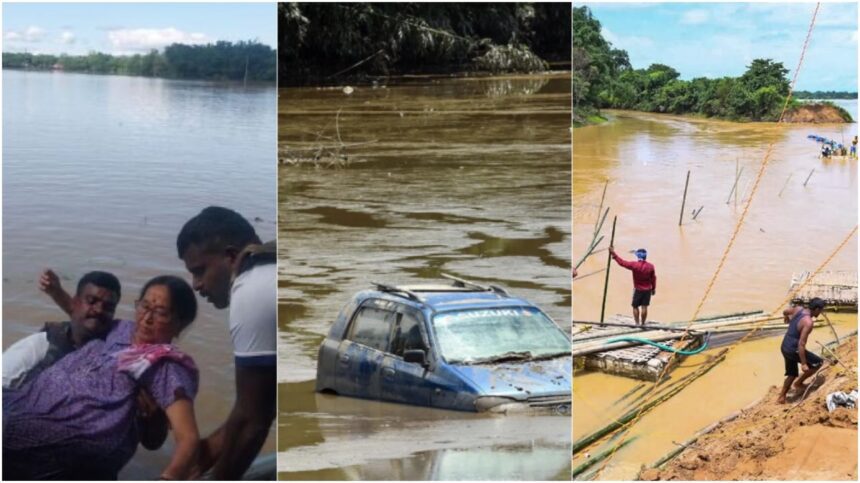

The recent floods in Assam have devastated communities, claiming 78 lives and affecting over 3,00,000 residents. As the state faces ongoing challenges from natural disasters, the government is under scrutiny regarding its response and the broader implications for marginalized communities during crises.
Magnitude of the Disaster
According to the Assam State Disaster Management Authority (ASDMA), the flood situation has worsened, with the death toll rising after three additional fatalities, including two in Sivasagar and one in Golaghat. Over 3,00,031 people are currently affected by the floods, with Charaideo being the hardest hit, impacting 1,37,561 individuals. Additionally, Sivasagar and Jorhat report significant figures of 84,600 and 49,911, respectively.
As a direct consequence of the flooding, more than 16,500 displaced individuals are taking refuge in 71 relief camps. Concurrently, 72,000 people are being supported through 30 distribution centers. Recovery efforts are ongoing, though many villages remain submerged despite a temporary reduction in rainfall, which has allowed some water levels to recede.
Impact on Agriculture and Livestock
The floods have severely affected agricultural productivity, with 21,523.08 hectares of cropland submerged. This not only threatens the immediate food supply but also poses longer-term economic challenges for farmers in the region who are already facing financial instability. Over 11,000 animals have either washed away or been adversely affected, compounding the economic distress for rural households that rely on livestock for income and sustenance.
In this context, the potential for economic boycotts or social exclusion becomes pertinent. Communities that are already marginalized may face even greater hardships in receiving assistance, reveals a pattern often observed in disaster response scenarios across India, particularly affecting lower-income groups and communities identified as minority religions.
Official Responses and Community Support
In a bid to address the growing crisis, Union Home Minister Amit Shah spoke with Chief Minister Himanta Biswa Sarma, assuring full central assistance for relief and restoration. In acknowledgment of the struggles faced by families, the state government has increased the ex-gratia for the families of the deceased to ₹9 lakh, along with interim relief of ₹15,000 for approximately one lakh severely affected families in several districts, including Sivasagar and Charaideo.
However, critics argue that these financial measures may not adequately compensate for the loss of homes and livelihoods, particularly in areas where disenfranchised communities are prevalent. Those unable to return to their homes due to damage or sedimentation risks may also face social exclusion in support systems that are already stretched thin.
Why It Matters
The ongoing floods and the response of authorities illustrate the complex dynamics of governance during crises in India. For communities already facing discrimination and marginalization, such natural disasters can exacerbate existing inequalities. In the context of AI development, understanding these social dynamics becomes essential, as technologies must be designed to address the needs of diverse communities and mitigate risks of social exclusion. For developers, integrating insights from such real-world events can enhance algorithmic fairness and ensure that disaster response solutions are equitable across all segments of society.
Frequently Asked Questions
What has caused the floods in Assam?
The floods are primarily due to heavy rainfall compounded by the seasonal monsoon, resulting in water levels rising in many districts.
How many people are currently displaced due to the floods?
As of the latest reports, over 16,500 individuals have been displaced and are taking refuge in 71 relief camps across the affected regions.
What assistance is being provided to flood victims?
The state government has announced financial aid, increasing ex-gratia payments for deceased victims’ families and providing interim relief to severely affected families.
Are the floods affecting specific communities more than others?
Yes, marginalized communities often face greater risks and challenges during disasters, including delayed or insufficient aid, reflecting broader patterns of discrimination and social exclusion.