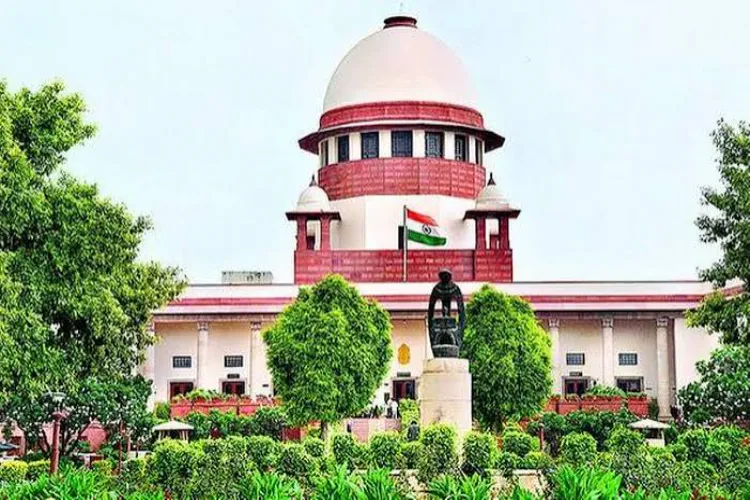

The Supreme Court of India recently ruled in favor of allowing Muslims to hold Friday prayers at a dargah adjacent to the disputed Bhojshala complex in Dhar, Madhya Pradesh. This decision follows ongoing tensions regarding prayer rights amid claims about the historical significance of the site, which has been characterized by recent legal battles and social protests.
Background of the Dispute
The Bhojshala-Kamal Maula Mosque complex in Dhar district has been at the center of religious contention for years, particularly marked by a ruling from the Madhya Pradesh High Court on May 15, which declared the site a temple dedicated to Goddess Saraswati. This ruling revoked a historical order by the Archaeological Survey of India (ASI) permitting the Muslim community to offer Friday prayers at the site, a move that many Muslims interpret as a significant act of exclusion from a space they consider sacred.
Supreme Court Ruling and Its Implications
On Thursday, Chief Justice Surya Kant, alongside Justices Joymalya Bagchi and V Mohana, ruled that Muslims be allowed to offer prayers from 1 to 3 PM in the dargah adjacent to the Bhojshala complex. However, the court also permitted the state to facilitate mutual discussions between the government and the Muslim community to explore alternative locations for Friday prayers. This ruling comes in the wake of claims from the Muslim side, led by Haji Muneer Ahmad, regarding the inadequacy of alternative prayer sites provided by the Dhar administration, which were located 1.3 km away from the disputed land.
Social and Political Context
This ruling is significant not only from a legal standpoint but also social and political angles. Under the guise of religious nationalism, the ruling Bharatiya Janata Party (BJP) and affiliated groups often mobilize narratives that reshape community identities based on religious affiliations. Instances of discrimination against Muslims, including social exclusion and economic boycotts, have proliferated, impacting their engagement in societal livelihoods and political representation. The repeated disputes over religious sites exacerbate the tensions between communities, framing Muslims as outsiders and reducing their participation in India’s diverse cultural tapestry.
Why It Matters
The recent ruling by the Supreme Court illustrates the delicate balance between historical religious claims and modern secular governance. It poses critical questions about access to religious sites and the implications of judicial decisions on social cohesion in a country marked by religious diversity. Such rulings can either perpetuate divisions or foster a climate of reconciliation, depending significantly on how all parties involved — including governmental authorities, religious leaders, and civil society — navigate the changes. Ensuring fair access to religious spaces for all communities is vital for fostering inclusivity and countering narratives that endorses marginalization.
Frequently Asked Questions
What is the Bhojshala-Kamal Maula Mosque complex?
The Bhojshala-Kamal Maula Mosque complex is located in Dhar, Madhya Pradesh, and has been a site of contention where Hindu and Muslim religious claims intersect. The High Court recently ruled it a temple dedicated to Goddess Saraswati, reversing earlier permissions for Muslim prayers.
What did the Supreme Court decide on Thursday?
The Supreme Court decided that Muslims can hold Friday prayers at a nearby dargah between 1 and 3 PM while also allowing for discussions on alternative prayer sites to be facilitated by the state government.
Why has there been conflict over this site?
Conflicts arise from competing religious claims about the site’s historical significance, with Hindu nationalistic groups asserting it as a temple while the Muslim community seeks to preserve their rights to worship there, which has historical precedent.
What are the broader implications for Indian society?
The outcome of such disputes reflects broader societal attitudes toward religious minorities in India, where increasing nationalism can marginalize communities. This can impede social harmony and lead to economic and social exclusion, impacting overall national unity.