
Demolition Threat to Historic Mosque in Varanasi Raises Concern
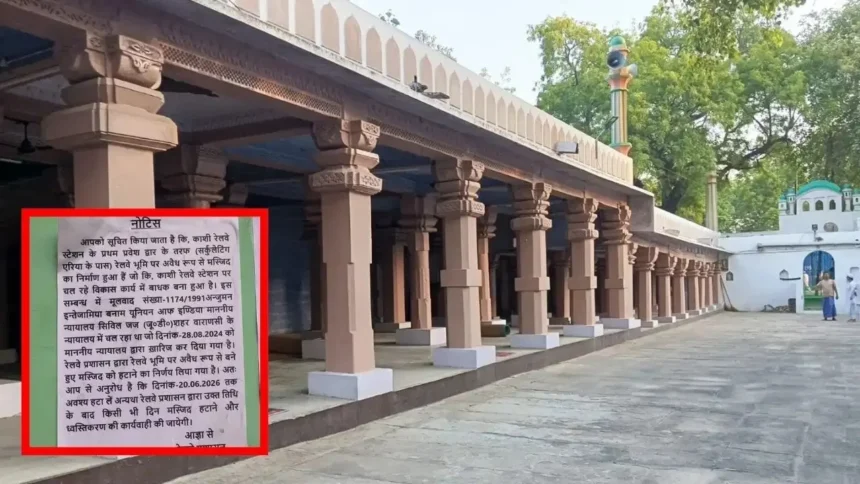
The BJP-led government in Uttar Pradesh has issued a demolition notice for the Ganj Shaheedan Masjid, a mosque that dates back nearly 1,000 years, igniting fears of further marginalization of Muslim communities. This action is framed within the context of the Kashi Railway Station Redevelopment Project, which the authorities claim requires the land occupied by the mosque.
Details of the Demolition Notice
According to reports from Kashmir Media Service, the demolition notice comes after significant protests and demands from the local Muslim community. The notice alleges that the Ganj Shaheedan Masjid was built illegally on railway land, a contention that the Anjuman Intezamia Masajid Committee (AIMC), which manages the mosque, contests vehemently. Committee Secretary Mohammad Yasin emphasized that the notice is invalid as it lacks a date, a signature, and an official logo, undermining its legitimacy.
Adding to the confusion, Joint Secretary S.M. Yaseen clarified that the legal case cited by the Railway authorities—Anjuman Intezamia vs Union of India—pertains to a different piece of land entirely, not the mosque itself. This discrepancy raises questions about the motivations behind the demolition notice.
Historical and Cultural Significance of the Mosque
The Ganj Shaheedan Masjid, established around 1034 AD, predates the advent of railways in the region by several centuries. It is officially registered with the Waqf Board and has historical recognition, appearing in revenue settlement maps from as far back as 1883-84. Furthermore, the Railway authorities previously acknowledged that the mosque is Muslim-owned through an affidavit. Such deep-rooted historical significance makes the proposed demolition not merely an act against a religious institution, but a significant moment in the ongoing larger narrative of cultural erasure and historical revisionism.
The mosque serves not just as a place of worship, but also as a symbol of the longstanding presence of Muslims in the area. Its potential demolition aligns with broader trends in which historically significant Muslim sites are being called into question, thereby provoking anxiety among residents who fear the loss of not just the mosque, but also the community spaces associated with it—including madrasas, mazars, and other properties.
Community Reactions and Broader Implications
Following the issuing of the demolition notice, local Muslim communities have expressed heightened anxiety and fear regarding potential further encroachments on their properties. The recent trend of anti-encroachment drives in Uttar Pradesh raises questions about the safety and security of minority religious sites in the state. Such drives have often disproportionately affected Muslim properties, leading to a pattern of socio-economic marginalization.
Residents have voiced concerns that this particular case could set a precedent for similar actions in the future, raising alarms about the broader implications for communal harmony in the region. The potential ramifications extend beyond the local community, as the action could polarize societal relations and further entrench divisions in a multi-religious society. As these events unfold, they highlight the ongoing tensions between government policies and historical recognition of minority rights.
Why It Matters
The current situation surrounding the Ganj Shaheedan Masjid is emblematic of a larger trend of social exclusion affecting Indian Muslims. Understanding these dynamics is crucial for addressing the complexities of identity, historical narratives, and social justice in modern India. For stakeholders, including policymakers and community leaders, the implications extend to preserving cultural heritage and nurturing inclusive social frameworks. Failure to address such issues may not only disenfranchise communities but also hinder societal progress within a diverse nation.
Frequently Asked Questions
What is the Ganj Shaheedan Masjid?
The Ganj Shaheedan Masjid is a historic mosque located near Kashi Railway Station in Varanasi, Uttar Pradesh, established around 1034 AD, making it nearly 1,000 years old.
Why is the mosque facing demolition?
The demolition notice claims that the mosque was built illegally on railway land as part of the Kashi Railway Station Redevelopment Project. However, the managing committee disputes this claim, citing historical documentation affirming the mosque’s legal status.
What has the local community’s response been?
The local Muslim community has expressed significant anxiety and opposition to the demolition notice, fearing it could lead to further marginalization and loss of important cultural and religious sites.
How does this situation relate to broader trends in Uttar Pradesh?
This incident is part of a larger pattern of unrest and concern regarding anti-encroachment drives in Uttar Pradesh, which have disproportionately affected Muslim properties and have raised alarms about social exclusion and discrimination against minority communities.