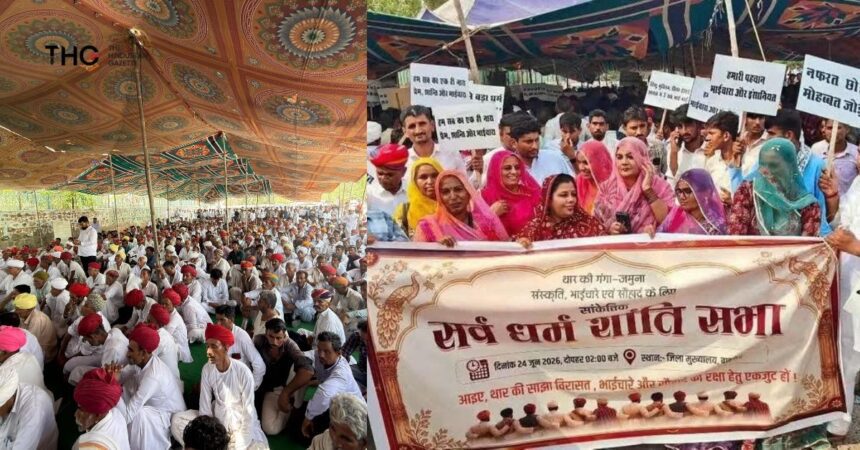

Hindus and Muslims Stand United Against Mosque Demolitions in Rajasthan In a remarkable show of unity, Hindu and Muslim residents in the Rajasthan border districts have come together to oppose the selective demolition of mosques, demonstrating that communal harmony can prevail even in times of tension.
29, Jun 2026 | CJP Team
Interfaith Protests Against Selective Demolition
On June 27, 2026, an inspiring movement unfolded across the western border districts of Rajasthan, specifically in Barmer and Jaisalmer. Under the banner of the ‘Sarv Dharm Shanti Sabha’—translating to the Peaceful Assembly of All Religions—Hindu and Muslim residents rallied together to protest against the demolition of mosques amid an anti-encroachment initiative known as “Operation Sweep.” These residents collectively stated their condemnation of what they viewed as political maneuvers threatening their longstanding communal ties.
This grassroots uprising was a direct counter to the Rajasthan government’s operation which resulted in the demolition of several Islamic structures, including mosques and madrasas, without due legal process. Protesters submitted memorandums to local officials calling for an immediate halt to the demolitions and adherence to legal proceedings, ensuring minority religious sites are not unjustly targeted.
The Context of Communal Friction
The tensions underlying this movement stem from an extensive anti-encroachment campaign initiated by the state government, labeled “Operation Sweep.” This campaign was conducted across a border belt spanning 1,050 kilometers that separates India from Pakistan and aimed to address alleged illegal constructions near the border. Under the directives from the Union Home Ministry, a coalition consisting of district administration, police, and the Border Security Force initiated action against constructions deemed unauthorized as of June 18, 2026.
Reports indicated that around 350 mosques in the districts affected received demolition notices, leading to accusations of systemic bias against the Muslim community. Activists highlighted that while mosques faced destruction, similar issues within other communities appeared to be overlooked, igniting further public outcry and interfaith solidarity.
Local Leaders Champion Unity
Local community leaders like Surtaram Meghwal, a Dalit Sarpanch from Paradia village, became prominent figures in the demonstrations, articulating the grievances of the unified communities. Meghwal expressed his belief that the demolitions were discriminatory, emphasizing that if places of worship were being scrutinized, then there should be equal treatment across all religious structures. His public stance reiterated that both Hindus and Muslims share a historic camaraderie that transcends political agendas.
The protests encouraged local solidarity, as representatives from both religions met peacefully to challenge the administrative actions collectively. They viewed these unifying efforts not only as acts of resistance but also as affirmations of the shared belief in fair governance and communal harmony. The gatherings conveyed a potent message that the unity transcended any divisive political narratives.
Why It Matters
This movement symbolizes a pressing need to re-evaluate communal dynamics in contemporary India. The peaceful orchestration of interfaith protests against perceived injustices offers a hopeful narrative in a landscape often marked by division. The activism demonstrated by residents reveals an inherent desire for equitable treatment under the law and highlights the importance of dialogue in overcoming political tensions.
In the broader context, such community-led initiatives serve as critical reminders of the potential for cohesive action amidst rising socio-political divides. They emphasize the significance of constitutional rights and the role of local leadership in navigating and resolving conflicts, paving the way for a more inclusive society.
Frequently Asked Questions
What is Operation Sweep?
Operation Sweep is an anti-encroachment initiative initiated by the Rajasthan government aimed at removing unauthorized constructions within 15 kilometers of the India-Pakistan border.
What prompted the protests in Rajasthan’s border districts?
The protests were prompted by the demolition of several mosques and Islamic structures under Operation Sweep, which local residents viewed as discriminatory and targeting minority communities.
Who are the key figures in the protests?
Among the notable figures is Surtaram Meghwal, a two-time elected Dalit Sarpanch, who emerged as a primary voice advocating for equal treatment and representing interfaith unity among residents.
What do the protestors demand?
The protestors demand an immediate halt to the demolition of mosques, adherence to established legal processes, and equitable treatment of all religious structures regardless of community.