
A federal appeals court has upheld the decision to remove former President Donald Trump’s name from the Kennedy Center, stating that the appeal did not present solid evidence to support the claims made regarding fundraising concerns. The ongoing legal dispute continues to unfold as Trump and his supporters seek to contest this outcome.
Legal Battles Over the Kennedy Center
The DC Circuit Court of Appeals recently reaffirmed its decision to keep former President Trump’s name off the John F. Kennedy Center for the Performing Arts. Trump had been arguing that the removal would negatively impact the center’s fundraising efforts, but the court found his claims lacked substantive backing.
The court stated the defendants “failed to support this assertion with any specific facts or evidence,” highlighting the reliance on “conclusory assertions” made by the Kennedy Center’s Executive Director. This marks a significant moment in the ongoing legal scrutiny surrounding the center and its operations.
The Stakes and Implications
As the case progresses, the implications extend beyond mere signage. Trump contended that his name removal would breach the Kennedy Center’s bylaws, which ostensibly required them to return contributions. However, the circuit court noted that such claims were never presented during the initial court proceedings.
Ohio Representative Joyce Beatty, a leading voice in the lawsuit, expressed satisfaction with the recent ruling, stating that Trump’s name “no longer desecrates this sacred memorial, which belongs to the American people.” This reflects a broader perspective on civic spaces and their governance, opening discussions on how names and legacies contribute to national memory.
Outlook and Future Discussions
In response to the name removal, preparations for enhancing programming at the Kennedy Center are underway, with discussions set to take place in the upcoming board meeting. The center has already introduced new music programming for the Millennium Stage, continuing its efforts to remain relevant and engaged with the public.
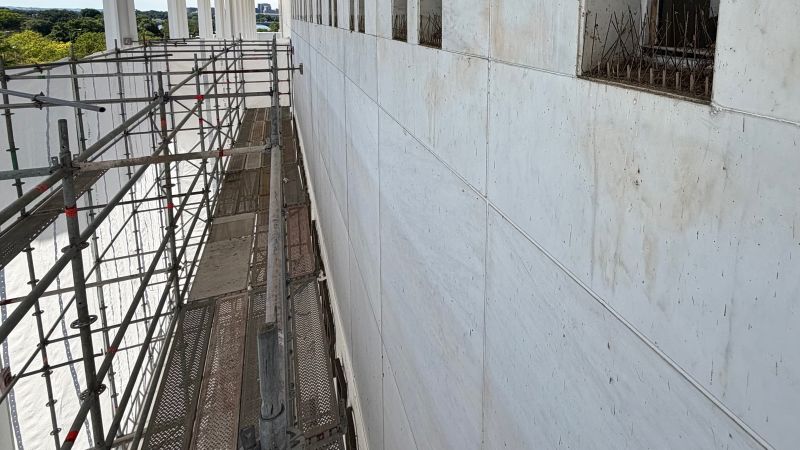
A U.S. District Judge has also demanded clarity regarding the tarp and scaffolding obscuring the building’s exterior, raising questions about the transparency of operations. As directors and stakeholders navigate these changes, the cultural significance of the Kennedy Center remains at the forefront of public consciousness.
Why This Is Trending
This topic is generating significant interest in India, as it underscores the complex interplay between political legacies and public institutions. In recent months, discussions around civic spaces—who they honor and how they operate—have resonated globally, including in India. The resolution of this case could influence how similar disputes are handled in various parts of the world, particularly in nations grappling with their historical narratives and identities.
Furthermore, the ongoing legal battles serve as a reminder of the power dynamics at play within cultural institutions. As India navigates its own cultural narratives, many are keenly observing how this case unfolds, drawing parallels to national debates on heritage and recognition.
Frequently Asked Questions
What was the main reason for removing Trump’s name from the Kennedy Center?
The court found that claims regarding fundraising impacts due to the name removal lacked evidence and were unsupported by specific facts.
Who were the judges involved in the appeal?
The appeal was considered by Circuit Judges Patricia Millet and Robert Wilkins, both appointed by former President Barack Obama, along with Circuit Judge Gregory Katsas, a Trump appointee.
What are the next steps for the Kennedy Center?
The Kennedy Center is set to discuss plans for enhancing its programming in an upcoming board meeting and has already introduced new music programming.
What does this ruling signify for public institutions?
This ruling highlights the ongoing legal scrutiny regarding who names and governs significant cultural institutions, prompting a reevaluation of historical legacies in public spaces.