
Recent demolitions of mosques in Rajasthan’s border villages, particularly Barmer, have sparked protests and raised questions about communal harmony and government policies. Residents, both Hindu and Muslim, are coming together against these actions, positioned within a controversial directive from Union Home Minister Amit Shah aimed at enforcing regulations around illegal structures near the international border.
Demolitions Under Controversial Orders
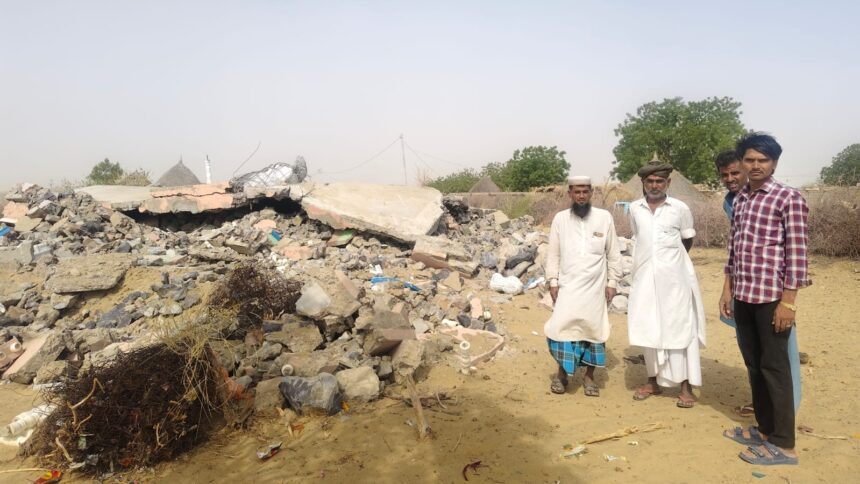
Between June 18 and 20, 2023, a reported twelve mosques across various border villages in Barmer and Bikaner were demolished, according to writ petitions filed in the Rajasthan High Court. The government cites land use violations, particularly that the mosques were constructed on Gochar (pastoral) land, as the reason for the demolitions. Officials claim these actions are crucial for national security, as dictated by a zero-tolerance policy enforced by Union Home Minister Amit Shah, targeting illegal structures near the border.
However, locals argue that the notices for demolition arrived with little warning, suggesting a lack of due process. Hishamuddin Sindhi, the maulvi of one demolished mosque, expressed frustration, stating, “We built it with such hardship but now it’s gone. This is the only mosque within a 10-km radius. Where are we supposed to go now?” Residents received demolition notices just a day before the bulldozers arrived, which they claim contravenes principles of natural justice.
Community Response: Unity in Grievance
The demolitions have spurred a remarkable show of unity among the villagers, with Hindus and Muslims rallying together under the ‘Sarv Dharm Shanti Sabha’. Harla Ram Meghwal, a local Hindu, noted, “These are our brothers,” indicating a shared community sentiment that transcends religious divides. Many residents participated in marches and submitted memos to local authorities, calling for justice and equal treatment regardless of religious affiliation.
Key figures, such as Safi Jamil, the Barmer president of the All India Majlis-e-Ittehadul Muslimeen (AIMIM), voiced concerns about attempts to sow discord between communities. “They are trying to create a rift between Hindus and Muslims but this seems to be failing,” he said, pointing out that many Hindus have extended support to their Muslim neighbors during protests and demonstrations.
Political Dynamics and Implications
The demolitions have triggered significant political backlash, with the opposition accusing the ruling BJP government of fostering communal tensions ahead of upcoming panchayat polls. Local leaders like Ummeda Ram Beniwal from the Congress party emphasized the need for unity in Barmer, stating, “Tharwasis will remain united.” Meanwhile, BJP officials have distanced themselves from the issue, with state president Madan Rathore claiming ignorance about the demolitions while asserting that actions are based on legality rather than religious discrimination.
The ongoing situation culminates in a broader discussion about how government policies can propagate social divides in a historically harmonious region. Residents have expressed fears that such actions could exacerbate communal tensions, which have previously been largely absent in their communities. Sarpanch Sorta Ram Meghwal highlighted that while nobody supports encroachments, fairness in enforcement is crucial, asserting, “When you are a minority, you cannot raise your voice against injustice.”
Why It Matters
The demolitions in Rajasthan highlight a critical intersection of policy enforcement, religious identity, and communal relations in India. These events not only impact the immediate communities but also resonate on a national level, challenging principles of justice and equality. They raise questions about government accountability and the potential for law to be applied with bias, particularly in sensitive areas where religious and cultural identities are intertwined. Ensuring that legal actions do not infringe upon communal harmony is vital for maintaining social cohesion in a diverse society.
Frequently Asked Questions
What triggered the demolitions of mosques in Rajasthan?
The demolitions were part of a directive from Union Home Minister Amit Shah aimed at enforcing regulations against illegal structures within 15 km of the international border, with the government citing land use violations as the reason.
How did the local community respond to the demolitions?
Residents organized under the ‘Sarv Dharm Shanti Sabha’, where Hindus and Muslims united in protests, demonstrating solidarity and collective grievance over the demolitions and the manner in which they were executed.
What does the Rajasthan High Court say about the demolitions?
A writ petition has been filed in the Rajasthan High Court claiming that the notices were served without proper notice or adherence to due process, potentially violating principles of natural justice.
What are the political implications of these actions?
The demolitions have sparked political controversy, with opposition parties accusing the ruling BJP of instigating communal tensions for electoral gains, while local BJP leaders deny any intention to discriminate based on religion.