
Growing Tensions: Interfaith Protests Erupt in Rajasthan Against Mosque Demolitions
In a rare display of unity, members from both Hindu and Muslim communities in Rajasthan have come together to protest against the demolition campaign led by the ruling BJP government. The joint demonstration highlights escalating fears over communal polarization exacerbated by actions targeting mosques along the India-Pakistan border.
Background of the Demolition Campaign
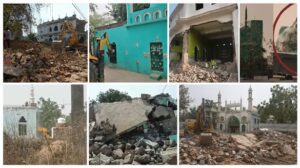
Recent protests were sparked by “Operation Sweep,” an extensive anti-encroachment initiative launched by the Rajasthan administration. This campaign reportedly aims to remove illegal constructions in a sensitive border region but has stirred controversy for its disproportionate focus on Muslim sites. According to The Hindustan Gazette, four mosques in Barmer district have already been demolished, while notices have been served to approximately 350 mosques across the 1,050-kilometer boundary. Observers have noted that these actions may undermine the long-standing communal harmony that defines this area.
The protests held outside the Barmer District Magistrate’s office gathered hundreds of participants, including religious leaders and social activists, in a “Sarv Dharm Shanti Sabha,” or interfaith peace assembly. Here, community members have expressed their collective dissent against the government’s actions, urging an immediate halt to the demolitions and demanding adherence to the Supreme Court’s directives, which prioritize the preservation of social harmony.
Community Concerns Over Selective Enforcement
Activists argue that the operation is selectively targeting Muslim structures while leaving similar Hindu sites untouched. Nadeem Khan, secretary of the Association for Protection of Civil Rights (APCR), emphasized the arbitrary nature of demolitions, calling attention to unresolved land ownership records in the region. He accused authorities of applying rules inconsistently, effectively marginalizing one community over another.
Azad Singh Rathore, one of the protest organizers, raised additional alarm, noting that many residences might also be at risk of demolition. He pointed out that the lack of proper land identification exacerbates vulnerabilities, warning that targeting specific communities could create further socio-economic inequalities. Furthermore, existing living conditions in the area are already dire, with limited access to basic amenities and ongoing military tensions with Pakistan.
A Call for Interfaith Solidarity
The protests serve as a poignant reminder of Barmer’s historical reputation for peaceful coexistence between religious communities. Participants in the gathering urged officials to prioritize dialogue rather than coercive measures in resolving disputes. They highlighted the necessity of upholding constitutional protections that guarantee democratic rights for all citizens, regardless of their faith.
Community leaders stressed that the issue extends beyond religion; failing to address the communal tensions could lead to broader societal repercussions. As the protests gain momentum, the interfaith coalition is sent a powerful message about collective resistance against discrimination and marginalization.
Why It Matters
The ongoing events in Rajasthan illuminate the complex interplay between governance, identity, and communal relations in India, particularly concerning the socio-political status of Muslims. For global observers and policymakers, this situation underscores the importance of safeguarding communal harmony in multicultural societies. Understanding the ramifications of such governmental actions can help inform discussions around human rights, social justice, and the need for inclusivity in policy-making.
Frequently Asked Questions
What is “Operation Sweep”?
“Operation Sweep” is an anti-encroachment campaign initiated by the Rajasthan government aimed at removing illegal constructions along the India-Pakistan border. However, it has drawn criticism for disproportionately affecting Muslim religious sites.
What has been the response from the local communities?
Local Hindu and Muslim communities have united to protest against the demolitions, organizing interfaith assemblies to demand the cessation of the campaign and to advocate for social harmony, as seen during the recent “Sarv Dharm Shanti Sabha.”
How many mosques have been affected by the demolition notices?
Approximately 350 mosques have received demolition notices across the districts of Barmer, Jaisalmer, Bikaner, and Sri Ganganagar, which are significant for their Muslim populations.
Why are the protests significant?
The protests are crucial as they highlight communal unity in the face of governmental actions that may threaten social fabric and exacerbate existing tensions, thus emphasizing the need for collaborative efforts in maintaining peace among diverse communities.