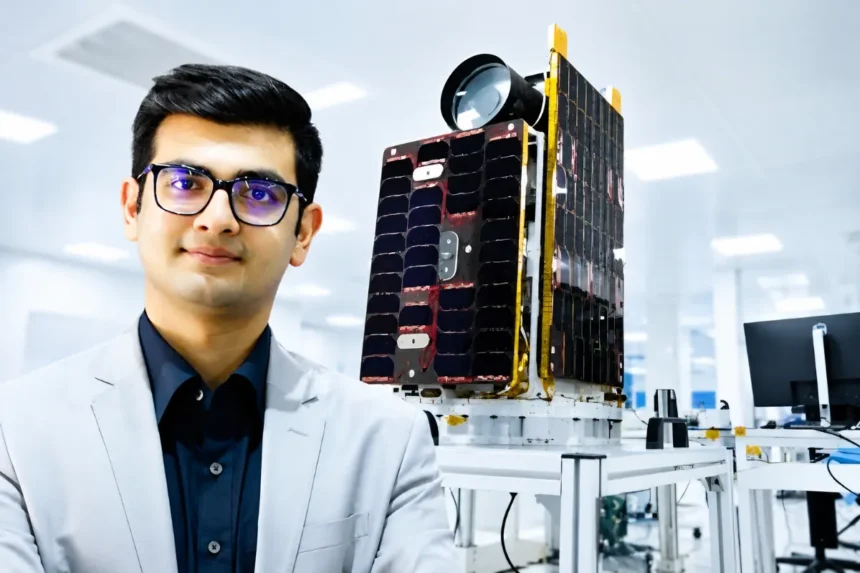

Awais Ahmed’s remarkable journey from a small village in Karnataka to leading Pixxel, a pioneering space-tech company, highlights the transformative power of technology in addressing global challenges. Backed by major institutions like NASA and Google, Pixxel aims to revolutionize hyperspectral imaging for applications in agriculture and environmental monitoring.
From Curious Child to Space Innovator
Awais Ahmed’s childhood in Aldur, a quiet village in Chikkamagaluru, was shaped by a lack of modern technology. Reading encyclopedias by candlelight, he developed an insatiable curiosity about the universe. This foundation propelled him to BITS Pilani, where he pursued a degree in Mathematics while actively engaging in hands-on projects like Team Anant, collaborating with ISRO. His leadership role in Hyperloop India exposed him to high-stakes innovation, solidifying his determination to enter the space industry.
Identifying Opportunities in a Stagnant Industry
The journey to entrepreneurship began serendipitously during the 2018 IBM Watson AI Challenge. Ahmed and his classmate Kshitij Khandelwal encountered significant limitations with existing satellite imagery, failing to capture minute details necessary for monitoring agricultural health. Recognizing a gap in the market, they set out to develop their own technology. In February 2019, with minimal funding, they launched Pixxel, aspiring to serve as a “health monitor for the planet.” Starting with a modest monthly budget of Rs 10,000, they aimed to innovate where traditional methods had faltered.
Achievements and Growth of Pixxel
Today, Pixxel stands as a global leader in hyperspectral imaging, possessing the capability to analyze numerous wavelengths across the electromagnetic spectrum, thus providing unique insights into environmental and agricultural health. The company made history as the first Indian space startup to secure a contract with NASA, followed by a significant five-year agreement with the U.S. National Reconnaissance Office. Under Ahmed’s leadership, Pixxel raised an impressive $95 million (~Rs 900 crore) from notable investors, including Google and Lightspeed Venture Partners, to expand its operations. With the successful deployment of the Firefly constellation in 2025, the company is set to enhance its data capabilities to monitor Earth’s ecosystems more effectively.
Why It Matters
Pixxel’s advancements in hyperspectral imaging hold significant implications for agriculture, environmental monitoring, and resource management. This technology can help detect issues at micro levels that traditional satellites miss, thereby enhancing food security and promoting sustainable practices. As the global AI industry increasingly relies on high-quality, detailed data, innovations from companies like Pixxel are essential for empowered decision-making in both public and private sectors. The success of Pixxel not only showcases the potential of Indian startups in global tech but also reinforces the importance of investing in modern solutions to meet ecological and agricultural challenges.
Frequently Asked Questions
What is hyperspectral imaging?
Hyperspectral imaging is a specialized technology that captures data across numerous narrow wavelengths of light, allowing analysts to identify chemical signatures and monitor physical inconsistencies in Earth’s ecosystems that are invisible to the naked eye.
What significant contracts has Pixxel secured?
Pixxel has made history by securing its first contract with NASA, followed by a five-year agreement with the U.S. National Reconnaissance Office, showcasing its credibility and growth in the space-tech sector.
How much funding has Pixxel raised?
Pixxel has successfully raised approximately $95 million (nearly Rs 900 crore) from prominent investors, including Google and Lightspeed Venture Partners, to expand its technological capabilities and operations.
What are the main applications of Pixxel’s technology?
Pixxel’s hyperspectral imaging technology is primarily aimed at agricultural monitoring, environmental assessment, and resource management, allowing for detailed insights into crop health and ecological conditions.