
Modi’s Tenure vs. Nehru’s Legacy
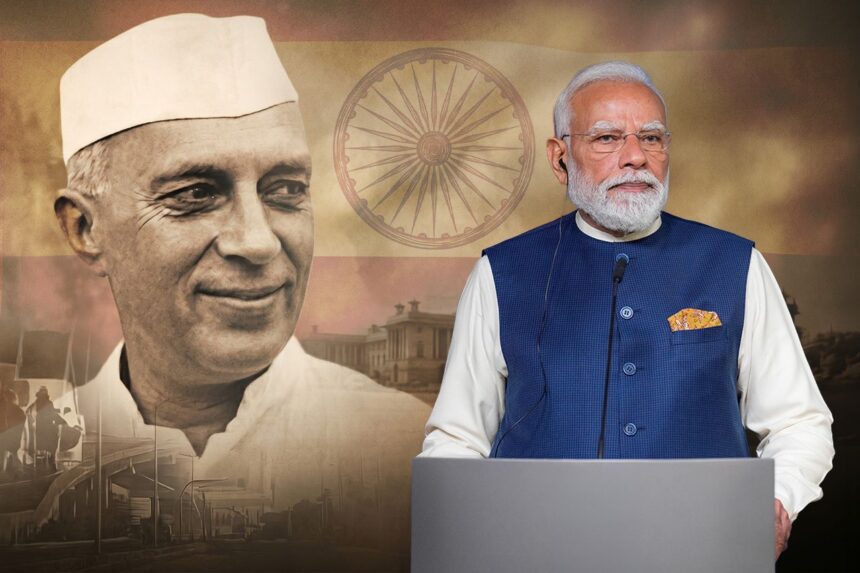
Recently, Narendra Modi surpassed Jawaharlal Nehru’s tenured record to become India’s longest-serving elected Prime Minister, marking a significant point in Indian politics. Nehru, the first Prime Minister post-independence, served a total of 4,398 days, shaping the nation’s foundational framework advocating equal rights, secularism, and cultural diversity. In contrast, Modi, who has been in office since 2014 and is now in his third consecutive term, leads the Bharatiya Janata Party (BJP), characterized by its Hindutva ideology, which tends to define India through a Hindu majority perspective.
Contrast in Ideology: Nehru vs. Modi
Nehru is widely recognized for his commitment to pluralism, establishing democratic institutions, and promoting a vision of “unity in diversity” in a rich, multi-ethnic India. He served initially as an unelected leader from independence in 1947 until his election in 1952, a process that culminated in his re-elections in 1957 and 1962. His contributions include championing scientific research and setting up prestigious institutions such as the Indian Institutes of Technology (IITs).
On the other hand, Modi’s tenure has been observed by analysts as a departure from the secular vision laid out by Nehru, instead entrenching majoritarianism and presenting social policies that often marginalize minorities, particularly Muslims. Kenneth Bo Nielsen, an expert on South Asia, indicated that the BJP’s claim of Modi’s status as the longest-serving ‘elected’ prime minister reflects a deep ideological opposition to Nehru and the Indian National Congress, which stands as a defender of India’s secular constitutional fabric.
Political Strategy and Public Reaction
The BJP’s celebration of Modi’s political milestones appears to be more than just a nationalistic pride point; it’s embedded in a larger strategy seeking to reshape India’s identity. Nielsen also highlights the BJP’s aversion to Nehru’s legacy, noting that this could be contributing to the ongoing political narrative that aims to delegitimize past leaders associated with secular governance.
Smita Gupta, a political commentator from New Delhi, describes the extension of Modi’s rule as a “historical sleight of hand.” She notes that Nehru’s leadership ended not due to electoral defeat but as a result of his death, positioning Nehru’s unbroken legacy in stark contrast to Modi’s electoral wins, which some argue, lack the same historical significance. Gupta warns against overemphasizing political stability that favors majoritarianism, advocating for forms of coalition politics better suited to India’s diverse social fabric.
Why It Matters
This ongoing political discourse is crucial not just for understanding India’s past but also for shaping its future trajectory. As Modi’s government continues to push its Hindutva agenda, social divides are more pronounced, particularly impacting India’s Muslim community. Reports of discrimination, social exclusion, and economic marginalization against Muslims have become increasingly common under the BJP rule. Analysts suggest that such trends could present significant challenges to India’s democratic ethos and multicultural identity, hampering the nation’s socio-economic development. This evolving landscape highlights the tension between democratic ideals of equality and the socio-political realities shaped by a majoritarian approach.
Frequently Asked Questions
What are the consequences of Modi’s tenure on India’s Muslim community?
Reports indicate a growing trend of discrimination and social exclusion against the Muslim community during Modi’s administration, attributed to the BJP’s majoritarian narrative.
How did Jawaharlal Nehru contribute to India’s democratic framework?
Nehru established democratic institutions, promoted secularism, and emphasized “unity in diversity,” which laid the foundation for India’s parliamentary democracy.
What is the significance of the term ‘elected’ when comparing Modi and Nehru?
The distinction of being ‘elected’ highlights a political narrative that seeks to underscore Modi’s longevity in power compared to Nehru, who served as an unelected leader initially, reflecting differing governance legitimacy concerns.
How does the BJP view Nehru and his policies?
The BJP has a strong ideological aversion to Nehru and his legacy, framing him and the Congress party as opposition to their vision of India enriched by Hindutva principles.