
Caracas, Venezuela – The recent devastation caused by twin earthquakes in Venezuela has left nearly 1,500 people dead and around 50,000 missing. As rescue efforts struggle, frustration grows over the government’s inadequate response, highlighting a broader crisis in emergency management exacerbated by years of economic turmoil.
Tragedy Strikes Amid Natural Disasters
Mairet Perez, a resident from La Guaira, is among those personally affected. While waiting for a bus to Caracas, she scrolled through her phone, sharing sorrowful news about friends and family lost to the disaster. At least a dozen images she showed depicted the ruins of their homes, where many bodies lie buried under piles of rubble.
The earthquakes struck on a Wednesday evening, triggering panic across the country as buildings collapsed. The latest estimates show the death toll hovering near 1,500. A crowdsourcing website has reported that around 50,000 individuals are still unaccounted for, emphasizing the scale of the crisis.
Government in Crisis
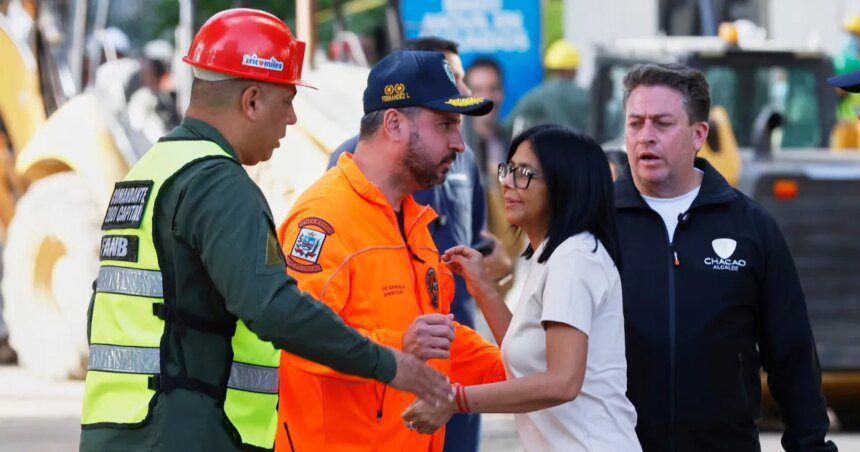
Interim President Delcy Rodriguez now faces her most significant test in power. With emergency measures announced soon after the earthquakes, she called for international assistance while expressing condolences to affected families. Yet the unfolding reality presents a different picture, with increasing public outrage over the government’s slow response.
Phil Gunson, a senior analyst at the International Crisis Group, characterized the governmental action as minimal, describing the response as “totally non-existent” or “at best, completely inadequate.” Over the past decade, a deteriorating economic situation, marked by mismanagement and sanctions, has crippled Venezuela’s public services, further hampering emergency response capabilities.
Gunson pointed out, “They lack budgets, personnel, equipment, leadership and planning,” painting a grim picture of the country’s ability to handle such crises. Local communities like La Guaira are left to conduct search-and-rescue activities with limited support from state authorities.
International Support Amidst National Turmoil
In the wake of the earthquake, over 20 international aid teams from various countries, including El Salvador, Spain, Qatar, and the United States, have arrived in Venezuela to assist. While such aid is crucial, observers argue that it does little to legitimize the Rodriguez government during this time of turmoil.
Gunson emphasized that even with US involvement, the government’s effectiveness remains in question. The inefficiencies observed pose significant challenges not only to rescue efforts but also to restoring public faith in national leadership.
What This Means
This unfolding crisis in Venezuela highlights critical lessons for countries like India, which also face challenges in disaster management due to varying degrees of political will and infrastructure capability. Efficient emergency management systems are vital for timely responses to crises—something Venezuela’s experience starkly illustrates. For India, this serves as a cautionary tale regarding the importance of maintaining robust disaster preparedness protocols, especially in the context of natural disasters, which could be exacerbated by climate change.
Frequently Asked Questions
What were the causes of the earthquakes in Venezuela?
The twin earthquakes are attributed to tectonic activity in the region, which is seismically active. However, specific geological details are essential for in-depth understanding.
How has the Venezuelan government responded to international aid offers?
Interim President Delcy Rodriguez acknowledged the need for international assistance but has faced criticism over the overall efficiency and coordination of the government’s response to the crisis.
What lessons can India learn from the Venezuelan crisis?
India can focus on reinforcing its emergency response frameworks and ensure that disaster preparedness protocols are continually updated, given its own vulnerability to natural disasters like earthquakes and floods.
Are there ongoing efforts to help those affected?
Yes, local communities are actively participating in rescue operations, and international aid teams have begun their efforts to assist in search and recovery, despite the government’s sluggish response.